Gallery

August 19, 2021
We will certainly be able to sustain the kind of profitability in chlor-alkali as well as derivatives segment together: Maulik Patel, CMD, Meghmani Finechem
It was a momentous occasion for Meghmani Finechem Limited yesterday as the company got listed both at BSE and NSE. The company is set to become India’s first manufacturer of Epichlorohydrin (ECH), so far imported entirely for domestic consumption. The company is also setting up a Chlorinated Polyvinyl Chloride (CPVC) manufacturing plant in India.
Despite his busy schedule, Maulik Patel, Chairman & Managing Director, Meghmani Finechem Limited spoke exclusively to Pravin Prashant, Editor, Indian Chemical News about the company's revenue target of Rs. 2,000 crore by FY2024, profitability numbers, mega expansion plans, capex plans, plant automation, achieving net carbon zero, and others. Excerpts of the interview:
Meghmani Finechem is looking at expanding the caustic soda plant and is planning new facilities for epichlorohydrin and chlorinated polyvinyl chloride? What's your expansion plans?
As per our big capex plan, we have just completed the commissioning of products like caustic soda, hydrogen peroxide and captive power plant in the last financial year. In this financial year, we are going to get the result of all the capex invested in the last few years. The epichlorohydrin project with capacity of 50,000 tonnes per annum, will be manufactured for the first time in India, was initiated in the last fiscal and is going to be completed in the first quarter of FY23. It is a basic building block of epoxy resin. With regard to CPVC, we have also started the capex from the second half of last fiscal and it is going to get completed by the second quarter of FY23.
Both the capex plans are on the stream and even though after the second wave, we faced manpower shortage and we have managed to cover all such delays in the last 3-4 months. Therefore, the commissioning of both ECH and CPVC are on time in the first and second quarters of FY23 respectively.
Capex breakup with respect to caustic soda, ECH, and CPVC?
In the last phase of caustic soda expansion, we have done the majority of the things required for Chlor-Alkali and the captive power plant. So we are doing only Rs. 250 crore capex for the chlor-alkali for the power plant expansion for plants with 300 TPD capacity. For ECH, we are doing Rs. 275 crore capex for expansion upto 50,000 tonnes capacity plant and we are investing Rs. 190 crore capex on the 30,000 tonnes capacity plant of CPVC.
You seem to be staggering your capex for the next three years - FY 21, FY 22, and FY23. Can you give a Capex breakup for three years?
As I mentioned, we are moving from just chlor-alkali to the derivatives segment. As a result, the first phase of expansion of caustic soda, captive power plant and hydrogen peroxide was completed last fiscal. So, we are going to get full results in the current fiscal and the results of ECH and CPVC in the next fiscal. As far as capex is concerned, we have spent Rs. 150 crore in the last fiscal on our three projects. We are going to spend Rs. 350 crore in the current fiscal and Rs. 100 crore in the next financial year.
In the next three years, Meghmani Finechem is planning to increase its revenue from Rs. 829 crore to Rs. 2,000 crore. How easy or difficult this challenge would be and revenue breakup with respect to caustic soda, ECH, and CPVC in FY24?
As a part of our long-term vision, we decided in 2019 to work towards achieving Rs. 2,000 crore revenue by FY24. Because of the great team effort, we are hopeful to achieve the revenue target probably a little early and that is our aim. Currently, 70% is coming from chlor-alkali and the remaining 30% from derivatives of chloromethanes and hydrogen peroxide. In the current financial year, the share of Derivatives is likely to increase to 35% and 65% share will remain for chlor-alkali.
In the coming years, it will be more than 50% from the derivatives segment as ECH and CPVC will start commissioning and generating revenue. Less than 50% will be from chlor-alkali itself.
In FY24, will it be equal revenue share for ECH and CPVC or will it be different?
ECH will be the number one contributor in the derivatives segment but at the same time, the exact bifurcations keep changing in the derivatives because of the dynamic raw material scenario. It is difficult to predict the exact revenue but a major chunk is going to be from ECH among all derivatives.
What about the profitability numbers in FY24?
Going by our track record, we were able to maintain profitability irrespective of whether we had started the derivatives or not. Even in the chlor-alkali segment itself, our profitability is going to be 28-30%. Down the line, even if we reach the Rs. 2000 crore topline, we will certainly be able to sustain the kind of profitability in chloro-alkali as well as the derivatives segment together.
Both ECH and CPVC will be manufactured for the first time in India. Being the first to manufacture these two products in India, how does it feel?
It feels great that as a domestic manufacturer, we are moving towards achieving the dream of our Prime Minister, which is Atmanirbhar Bharat or self-reliant India. ECH will be the first of its kind manufacturing in India for the 50,000 tonnes plant and that will reduce the import bill. For CPVC, the market is huge, around 135 KTPA per annum and only 10,000 tonnes manufacturing capacity in India. We are coming with 30,000 tonnes and it is the second manufacturing plant in India. I think till there is a huge demand-supply gap in all the products, there is always an opportunity. And the way India is growing, infrastructure, automobile, renewable energy, and composites industry segments are growing, the demand for ECH and CPVC will register double digit growth in the coming years.
Which sector will benefit most from these derivatives - ECH and CPVC? Are you also looking at the export market?
Currently, our focus is only on the domestic market and in case it is required we will take a call based on realization of price in the future. It will be 80:20 ratio, out of which 80% will be for domestic and 20% for export.
How are you moving towards automated plants?
At Meghmani, whatever we are manufacturing are all continuous plants, starting from chloro-alkali to captive power plant and chloromethane to hydrogen peroxide and now two new product lines that we are coming with. We are going for 100% automation irrespective of the quantity. We believe that in the coming times there will be less manpower required for certain operations and automation will be better for the quality of the product itself.
Wouldn't complete automation lead to an increase in capex?
Initially, we were going for an 80:20 kind of arrangement where it would be automation for 80% of higher volume products and manual for the remaining 20% small volume ones. However, now we are going for fully automated ones and yes, we are well aware about the increase in the cost. We believe that given the increasing cost and dependency on manpower and the situation like COVID-19, it is better for productivity of plants in coming times.
With respect to ECH with 100% renewable energy, are you going for the same for caustic soda and others?
As of now we don't have plans for renewable energy as we are waiting for the policies in this direction. However, as we are dependent on electricity power, we would like to go for green sources of energy. In ECH, our technology is based on glycerine as a feedstock, which is completely a renewable source as it comes from a byproduct of a biodiesel plant. Therefore, we are reducing the carbon footprint in India as compared to western companies that normally use Propylene.
Are you looking at achieving net carbon zero in the coming times?
Currently, for the next 2-3 years, we don't have a plan but like every other company, we too are determined to go completely renewable in the near future. While we don’t have it in our strategy right now, we will start investing in it during the coming times.
July 15, 2021
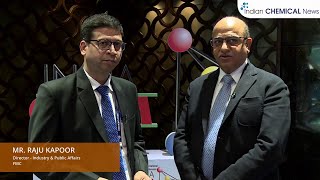
Consumer preference towards safer food brings new technology in the industry : Raju Kapoor, Director of Industry & Public Affairs, FMC India
We are enriching farmer's buying capacity. We see that the production of horticultural crop is going up. This is helping in adaptation to the newer technology. Consumers demand for safer food is forcing industry to bring new technology for safer foods.

July 12, 2021
We are making fresh investment of Rs. 500 crore in downstream projects: Kaushal Soparkar, MD, Meghmani Finechem
The world is looking at India as a rising chemical sector country and this is going to benefit all chemical players. Meghmani Finechem invested Rs 800 crores in the last 3 years.
July 12, 2021
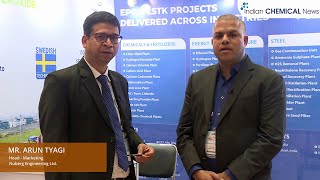
Lot of demand for hydrogen peroxide, chlorine derivatives and intermediates: Arun Tyagi, Head - Marketing, Nuberg Ltd
We are taking up a lot of initiatives on hydrogen. We are recognised as one of the most active players in the Middle East. Nuberg sees a lot of enquiries coming up from chemical and hydrogen peroxides and chlorine derivatives.
June 23, 2021
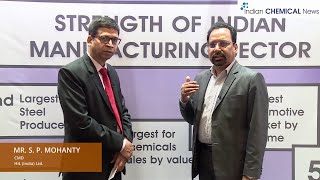
HIL India targets Rs 1000 crore revenue in 2021-22: S P Mohanty, CMD, HIL(India) Limited
Indian agrochemical sector is growing at a rapid pace. Many investments are coming in the Indian agrochemical industry. We have already proposed plans to the government for backward integration of our plants. We also have a JV with UPL Ltd and National Fertilizers Ltd. We have come up with an insecticidal mosquito net.
June 22, 2021
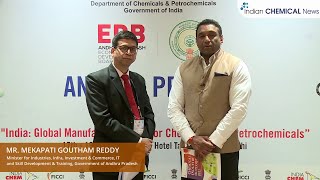
Andhra Pradesh is promoting PCPIR complex of state as the next Jamnagar of India : Mekapati Goutham Reddy
The state is looking to build self-sufficiency in petrochemical products and drive economies of scale for downstream chemical industries
June 16, 2021
New approaches to innovation will enable the manufacturing sector to reduce waste : A Mohammed, Director, Customer Solution Experience, India, Dassault Systemes
Azmathullah Mohammed, Director, Customer Solution Experience, India, Dassault Systemes talks exclusively to Pravin Prashant, Editor, Indian Chemical News on solutions offerings, clients in Chemical, Oil & Gas, Agrochemicals, and Pharmaceuticals, strategy for driving growth, accelerating sustainability and digital transformation, ‘ONE Lab’ industry solution, Drug Discovery hackathon, innovations planned, and incubating startups. Excerpts of the interview:
Clients in chemicals, oil & gas, agrochemicals, and pharmaceuticals who have deployed 3DEXPERIENCE in India and how are they utilizing this platform?
India is a key market for us and we work with different customers across these sectors to help them address various challenges related to business, innovation, and impact.
The key challenges faced by the chemical and oil & gas sector includes - environmental concerns and increasing public scrutiny, which is fuelling a shift in preference for alternative solutions that disrupt traditional business models. Various complexities arise from aging infrastructure and new, technically demanding assets. Our solutions can help the sector to address these challenges through digitalization and collaboration with an integrated approach that connects people, information, and processes across organizations, ecosystems, and value streams.
In agrochemicals, challenges range from finding new active ingredients to optimizing formulations to regulatory issues in connection with environmental fate or toxicology. Our simulation products aid development stages from finding a new active to generating additional thermodynamic data.
Pharmaceutical companies are under significant pressure to lower costs and to deliver therapies to smaller populations. Leading companies are investing in more flexible infrastructure, leveraging disposable and modular equipment in order to be more adaptive, mainly driven by the acceleration of biologics. Dassault Systemes has a deep understanding of the challenges faced by these companies and is committed to help them advance the pace of discovery of new drugs and medicines.
While attempting to resolve these challenges, many organisations have created cacophony of siloed digital softwares. This often leads to duplication of data, delay in timely notification of hazards leading to huge productivity as well as business loss resulting out of penalties. 3DEXPERIENCE Platform provides an open and an integrated platform approach to our customers to streamline their business processes, while fully understanding and including the legacy deployed solutions that are statutory or specific.
We have been working with several companies in power, oil and gas, chemicals, mining and metals in India. They boarded looking at the depth of our brand applications and industry solution experience offerings, which is seamlessly integrated on our 3DEXPERIENCE Platform.
Our solutions based on 3DEXPERIENCE Platform are adopted by industry innovation leaders such as 3M, DOW Chemicals, BASF, Akzo Nobel, Shell, BP, Chevron, Yeochun NCC, and many more.
What solutions does the 3DEXPERIENCE platform offer to the clients to help push boundaries of innovation, learning, and production? How can India's chemicals, petrochemicals, and pharmaceuticals industries benefit from 3DEXPERIENCE platform?
At Dassault Systemes, we have created solutions specific to the industry segments. These solutions are called Industry Solution Experiences. These solutions are based on the 3DEXPERIENCE platform that combine application, content and services, to enable unique and disruptive innovations in these sectors.
The key Industry Solution Experiences include: Capital Facilities Information Excellence (CFIE) Solution pan across the chemical, petrochemical, agrochemical, and pharma industry. The main deliverable of the CFIE is to provide a unified, platform based approach to integrated siloed information and siloed technologies to provide a Single Source of Truth for real-time monitoring and decision making.
Further, we also have specific solutions, which can augment targeted needs of the industry segments.
Chemical and petrochemical: Materials Excellence connects people, processes and data by removing barriers to data silos and democratizing advanced machine learning and in silico molecular modeling and simulation techniques to guide R&D in the identification and characterization of high performance materials.
Laboratory excellence supports laboratory organizations in Energy & Materials industries with an environment that facilitates and optimizes collaboration, experiment execution, documentation, and data management from R&D through manufacturing to commercialization. It helps to streamline laboratory operations, reformulate and improve product performance, and speed time to market.
Pharmaceutical: The License to Cure for BioPharma Industry Solution experience provides the ability to accelerate therapeutic development, approval, manufacturing, and supply, in a global landscape by leveraging an extensive, connected and comprehensive regulatory and quality platform.
Made to Cure for BioPharma provides deep digital capabilities and visibility across the enterprise and facilitates data-driven decision making for therapeutics supply.
Unique strategy developed by the company to drive growth of Dassault's customer base in India especially in the chemicals, petrochemicals, and pharmaceutical industry?
At Dassault Systemes, our growth strategy has these key pillars - Build on Value with the 3DEXPERIENCE platform, industry focus and cloud/mobile apps; Domain leadership through brand value creation; and improve efficiency by leveraging our sales channel coverage.
We have over 3,000 people working in sales & marketing, R&D, and global services. Furthermore, to select large and mid size customers in the energy and materials (E&M) industry we rope in global tech sales and support teams that are well abreast with the nature of the challenges in the sector. The E&M sector is such that the challenges are fairly similar globally and it is only the local policies, workforce capabilities and technical knowhow and digitalization in organisations that differentiates a global player to a player doing business in India.
Additionally, the specific challenge in these segments is adoption of digital technologies. While we have good domain knowledge specialists, it is difficult to find trained manpower on digital tools. One of the key initiatives at Dassault Systemes to drive growth is Workforce of the Future enabled through the Centre of Excellences for specific industry segments. We have many premier institutes on-board with us such as IITs, CIPET, and APSSDC to facilitate eligible and trained workforce.
How is the company accelerating sustainability and digital transformation in the chemicals, petrochemicals and pharmaceuticals sectors?
The Indian chemicals industry stood at US $178 billion in 2019 and is expected to reach US $304 billion by 2025 registering a CAGR of 9.3%. The demand for chemicals is expected to expand by 9% per annum by 2025. The chemical industry is expected to contribute US $300 billion to India’s GDP by 2025. Similarly according to the Indian Economic Survey 2021, the domestic market is expected to grow 3x in the next decade. India’s domestic pharmaceutical market is estimated at US $41 billion in 2021 and likely to reach US $65 billion by 2024 and further expand to reach around US $120-130 billion by 2030.
With the ambitious growth projections, sustainability is a key concern. UN Sustainable Development Goals 3, 6, 12, and 13 are the ones directly impacted through the processes of chemicals, petrochemicals, and pharmaceuticals industries.
At Dassault Systemes, we think of progress and innovation in terms of balance and impact. As we create value, what are we taking from our planet? As a part of our sustainability mission, we have initiated 12 actions to achieve our ambition to re-invent the sustainable economy. Further Dassault Systemes is today part of European Green Digital Coalition and Global Enabling Sustainable Initiative.
At Dassault Systemes, we strongly believe that virtual twins will be a key enabler for our customers – and the world – to imagine, design, and test the radically new products, materials, and manufacturing processes needed in tomorrow’s more sustainable economy. As part of our purpose to harmonize product, nature and life, we have a strategic ambition to become the world’s leading partner for reinventing a sustainable economy. Sustainable innovation can only be achieved by leveraging virtual worlds to imagine radically new materials, products and processes that reduce industry’s carbon footprint, and advance the circular economy.
Virtual worlds will enable industry to play its part in achieving the SDGs and in cutting GreenHouse Gas (GHG) emissions in half by 2030. New approaches to innovation, processes, and production will enable the manufacturing sector to focus on reducing waste, the life sciences sector to focus on new methods behind more targeted treatments, and the infrastructure and cities sector to focus on more sustainable ways to operate.
Virtual worlds with Dassault Systemes’ 3DEXPERIENCE platform and applications have already helped innovators pioneer new medical treatments, improve service deliveries in cities, and design a sculpture that absorbs pollution, confirming their role as a catalyst and enabler in a real world that is hyper vigilant about the availability of its resources and the well-being of future generations.
How has ‘ONE Lab’ industry solution of Dassault Systemes helped pharmaceutical companies to improve overall laboratory operational excellence and also support its digitalization journey?
Dassault Systemes ONE Lab Industry Solution Experience provides a standard foundation for the understanding and use of laboratory equipment, materials, and procedure steps, as well as a unified role-based user experience for the lab.
It helps pharmaceutical companies to design, develop, characterize, and release therapeutics more effectively at reduced costs with data-driven processes. It improves collaboration, innovation, and decision-making through an easier exchange of more consistent data and information. Further, it increased “Right First Time” through standardization and improved compliance with procedures and policies supporting the Quality and Regulatory initiative.
It provides a better understanding of the processes and data, providing knowledge to be used empirically or to build and refine models that can be used for future laboratory experimentation and testing. By integrating laboratory capabilities and applications through a laboratory-aware foundation, the solutions further help the companies improve operational excellence, support collaboration, and help enable faster time-to-market.
Dassault Systemes has partnered with Drug Discovery Hackathon (DDH2020), a joint initiative of AICTE, CSIR, CDAC, PSA, NIC and MyGov. How will this initiative help India?
In August last year, we partnered in the Drug Discovery Hackathon 2020 (DDH2020). Under this partnership, we offered the academic researchers, faculty, and participants of the hackathon access to our BIOVIA Discovery Studio, powered by 3DEXPERIENCE platform to assist in the search for rapid, safe, and effective therapeutic drugs against COVID-19.
Our solution provided the researchers with a complete toolset for use i.e. from target identification through lead optimization including tools for biologics design and analysis, classical simulations, structure- and fragment-based design, virtual ligand screening, as well as ADME (Absorption, Distribution, Metabolism, and Excretion) and toxicity prediction. This will help deal with designing/optimizing new tools and algorithms which will have an immense impact on expediting the process of in silico drug discovery.
This partnership aligned with our commitment to empowering the Life Sciences industry and the broader healthcare ecosystem, from those working in research and clinical development to manufacturing and patient care, at the forefront of the race to contain and fight COVID-19 in the country.
The 3DEXPERIENCE Lab in India is based out of Dassault Systemes’ R&D premises in Hinjewadi, Pune. What are the new innovations planned in 2021?
The 3DEXPERIENCE Lab offers entrepreneurs, makers, and start-ups unique resources to work on disruptive innovations, leverage collective intelligence, and nurture projects by continuing the trend in India and helping Indian start-ups grow and bring their projects to transform society. The start-ups will have access to Dassault Systemes’ cloud-based 3DEXPERIENCE platform and worldwide ecosystem to accelerate their product development process for two years with technical mentoring, marketing, and business development.
Some of the successful innovative startups that have signed with the 3DEXPERIENCE Lab in Pune are Brainsight.Ai, Padcare Lab, Inali and Lucid Implants. We have several other startups in the pipeline and coming from participants from 3DEXPERIENCE Pitch. Furthermore during COVID we have been working with students to foster frugal innovation. We worked with Nihaal to create the ventilation system in the PPE kit which has been in the news. We have also worked with students to design and develop bike ambulances. We continue to work on some stellar as well as frugal innovation from the 3DEXPERIENCE Lab in Pune.
What are your plans to incubate start-ups at the 3DEXPERIENCE Lab in India and technologies which they can collaborate with Dassault Systemes?
We drive various initiatives through the year to identify start-ups who can be incubated at the 3DEXPERIENCE Lab. During October- November 2020, we hosted a virtual hackathon, Drone-a-thon: Propelling Sustainability, aimed at inspiring students, start-ups, budding entrepreneurs and industrial companies to drive UAV and drone innovations powered by the 3DEXPERIENCE platform. The hackathon comprises a 10 days Design-Simulate-Experience challenge, in collaboration with 3DEXPERIENCE Lab. The hackathon provided a platform to inspire young minds to ideate, create futuristic drones and UAVs in India that can be manufactured locally to help farming and agriculture, city planning and surveillance, provide healthcare facilities and medical supplies in remote areas and help defence establishments in the country.
Further, we host 3DEXPERIENCE Lab pitches every year where startups can propose their idea to the jury and be offered mentorship, the cloud licence of 3DEXPERIENCE platform and brand applications to develop their product into a prototype in the next 2-3 years. We also work with Atal Incubation Center-SNU as Technology/Knowledge Partners to provide winners of their ‘Venture Challenge’ contest an extended support from the conceptual stage to actualization of their business concepts. We will help the chosen start-ups to scale their ideas, provide technical support, market guidance and access to their networks of key contacts for growth. Additionally, the best start-ups with breakthrough/disruptive innovation, collective intelligence, or those that aim to positively impact the society will get the chance to participate in the global pitch of 3DEXPERIENCE Lab.