The war did not create India's fertiliser problem. It exposed it

As the fertiliser industry meets in New Delhi this week for the FAI Annual Seminar, it can claim a quiet victory. When the West Asia war choked the Strait of Hormuz in late February, India's farmers did not run short. Urea and DAP stayed on the shelves, at the same prices as before.
That victory came at a cost, and the bill is still arriving. The Union Budget set aside Rs. 1.71 lakh crore for fertiliser subsidy this year. Approved spending on phosphatic and potassic fertilisers alone has crossed Rs. 1 lakh crore, against a budget of Rs. 54,000 crore. Total outgo is expected to exceed Rs. 3 lakh crore. Nine months into the conflict, DAP import deals are being struck at over $900 a tonne.
The war did not create India's fertiliser problem. It exposed it.
A subsidy that rewards the wrong nutrient
India runs two subsidy systems side by side. Urea sells at a fixed Rs. 266.50 for a 45-kg bag, a price that has barely moved in years. Phosphate and potash fall under the Nutrient Based Subsidy, with DAP effectively held at Rs. 1,350 for a 50-kg bag.
Work it out per kilogram of nutrient and the distortion is plain. A farmer pays about Rs. 13 for a kilogram of nitrogen in urea, but about Rs. 42 for a kilogram of nutrient in DAP. When one nutrient costs a third as much as the others, farmers use it in place of all of them.
They do. India applies nitrogen, phosphate and potash in a ratio of 10.5:4.1:1, against an agronomic norm close to 4:2:1. Farmers apply about 9 kg of potash a hectare where crops need 32 kg.
The soil is keeping score. Of 96 lakh soil samples tested last year, 72% were low in nitrogen and 52% low in organic carbon, despite decades of heavy urea use. Soils short of carbon cannot hold nutrients, so crops take up only 30–40% of the nitrogen applied. The rest is lost to the air and groundwater, and the exchequer pays for it.
Why the bill keeps rising
This waste sits on top of deep import dependence. About 86% of the LNG used by India's fertiliser plants comes from West Asia, and so does roughly 80% of the ammonia. India has little economic rock phosphate or potash. In 2025-26, it imported 28.2 million tonnes of fertiliser, and the import bill for fertilisers and raw materials reached $27.2 billion, second only to 2022-23.
Every kilogram of nitrogen that washes away must be imported again, paid for in dollars and subsidised in rupees.
What should change
None of this argues for scrapping subsidies. India's farmers, most of them smallholders, need protection from global price shocks. But that protection can reward efficiency rather than waste. Five steps would make a start.
First, bring urea under nutrient-based support in phases. A small, pre-announced price correction, paired with a per-hectare direct transfer, would protect farm incomes while ending nitrogen's artificial cheapness. The Economic Survey 2025-26 pointed in this direction.
Second, budget honestly. Under-provisioning the subsidy every year delays payments and turns fertiliser companies into lenders to the government. Annual, formula-linked NBS rates would let importers sign long-term contracts instead of buying on volatile spot markets.
Third, treat raw materials as strategic. That means national buffer stocks of urea, DAP and ammonia, equity in overseas phosphate and potash mines, and lower customs duty on ammonia, phosphoric acid and sulphur, so that making fertiliser in India pays.
Fourth, back new feedstocks. Coal gasification at Talcher and green ammonia projects at Kakinada and elsewhere can loosen the grip of imported gas, but only with long-term offtake and viability support.
Fifth, pay for outcomes. PM-PRANAM gives states that cut chemical fertiliser use half the subsidy they save. Its current term ran to 2025-26. A renewed scheme should reward balanced use and rising soil carbon, not just lower tonnage.
Industry's side of the bargain
Reform asks something of industry too. Companies must sell agronomy, not just bags, turning dealers into advisers backed by soil-test data. They should invest in customised, fortified and slow-release products, bio-fertilisers and organic manures, each backed by independent multi-season trials. And they must end practices such as tying one product to the sale of another, which the government had to ban this year. An industry that asks for reform must first earn trust.
Integrated nutrient management, which matches mineral fertiliser, organic manure and biological inputs to soil tests, is not a threat to the fertiliser business. It is its future. More grain per kilogram of nutrient means a smaller import bill, a smaller subsidy and healthier soil.
India came through 2026 without a fertiliser crisis. The next shock may not be so forgiving. The time to fix the system is while the lesson is still fresh.
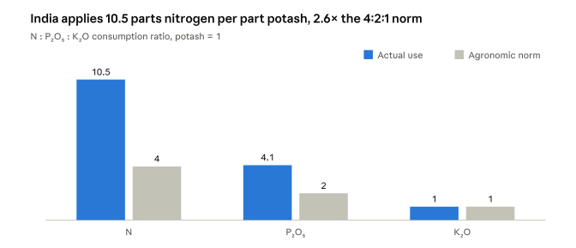
Actual ratio: ICRIER (2026); norm: Economic Survey 2025-26
(Raju Kapoor is the founder of Élan Growth Advisors and former Director – Corporate Affairs, FMC India. Views are personal.)
Subscribe to our newsletter & stay updated.