The 14th edition of India Chem brought together policymakers, industry leaders and international participants to discuss investment, manufacturing, technology, exports and supply-chain resilience.
Organised by the Department of Chemicals and Petrochemicals (DCPC), Ministry of Chemicals and Fertilisers, in partnership with the Federation of Indian Chambers of Commerce and Industry (FICCI), the event was held under the theme Advantage Bharat: An Emerging Global Chemicals Hub.
The event featured a Global CEOs Forum, India–US, India–Japan and India–EU forums, seven sectoral roundtables and the FICCI Chemicals and Petrochemicals Awards 2026. The exhibition brought together more than 200 Indian and international exhibitors, with over 8,000 business visitors and 50 leading Indian and international CEOs listed among the expected participants.
Japan was the partner country, while Maharashtra, Gujarat, Odisha, Madhya Pradesh, Bihar, Andhra Pradesh and Uttar Pradesh participated as partner states.
Government pushes investment, infrastructure and chemical parks
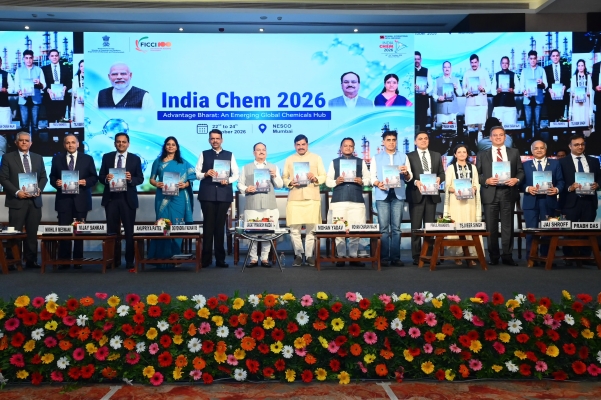
Union Minister for Health and Family Welfare and Chemicals and Fertilisers J.P. Nadda inaugurated the event on October 22, alongside Union Minister of State for Health and Family Welfare and Chemicals and Fertilisers Anupriya Patel, Maharashtra Chief Minister Devendra Fadnavis, Madhya Pradesh Chief Minister Dr Mohan Yadav and Odisha Chief Minister Mohan Charan Majhi.
Nadda said the government was providing a conducive environment for the chemicals sector and described the BHAVYA Rasayan Scheme as a potential game changer. He underscored the importance of connectivity to ports, railways, airports and roads, alongside integrated value chains, in developing globally competitive chemical manufacturing hubs.
A message from Prime Minister Narendra Modi, read out by Nadda, highlighted how ease-of-doing-business measures and free trade agreements could open new avenues for investment and international market access. The message expressed confidence that Indian chemical manufacturers would use these opportunities to strengthen their presence in global supply chains.
Fadnavis said Maharashtra’s chemical industry employs around three lakh people and that the state was preparing an investment-friendly policy. Dr Mohan Yadav and Mohan Charan Majhi invited businesses to explore opportunities in their respective states.
Patel called for closer collaboration between industry and state governments to implement the BHAVYA initiative, which includes plans for three dedicated chemical parks.
The push comes as India’s chemicals industry targets $300 billion by 2030 and $1 trillion by 2040. Achieving these ambitions will require greater domestic manufacturing capacity, stronger industrial infrastructure, technology upgrades and improved access to international markets.
Three international forums target global partnerships
International cooperation took centre stage through the Global CEOs Forum and the India–US, India–Japan and India–EU forums.
The Global CEOs Forum, chaired by Nadda and co-chaired by Patel and Odisha Chief Minister Mohan Charan Majhi, brought policymakers and business leaders together to discuss investment, innovation, competitiveness, supply-chain resilience and sustainable growth.
The India–US forum examined investment, trade, technology licensing, research and development, chemical parks, supply-chain resilience, green chemistry and decarbonisation.
The India–Japan forum focused on investment and research partnerships in advanced materials, semiconductors and battery chemicals, alongside efforts to strengthen supply chains. The India–EU forum explored trade and investment opportunities, technology transfer, regulatory cooperation and ease of doing business.
Together, the discussions highlighted the role of international partnerships in accelerating technology access, expanding manufacturing capabilities and connecting Indian producers with global markets.
Seven roundtables tackle industry bottlenecks
Seven sectoral roundtables held on October 23 focused on specialty chemicals, petrochemicals, infrastructure, environmental issues, process plant machinery, pumps and valves, and agrochemicals.
The discussions addressed challenges spanning manufacturing capacity, exports, logistics, equipment quality, technology adoption and sustainable production.
The specialty chemicals roundtable focused on research and innovation, sustainable manufacturing, exports and high-purity chemicals for advanced manufacturing. The petrochemicals session examined domestic capacity expansion, feedstock competitiveness, technology and export opportunities.
Infrastructure and logistics emerged as key priorities, with discussions highlighting connectivity, industrial capacity, integrated infrastructure and the role of chemical parks in strengthening supply chains.
The environmental issues roundtable addressed regulatory compliance, decarbonisation, resource efficiency, circular-economy practices and pollution control.
Meanwhile, the process plant machinery, pumps and valves session examined indigenous manufacturing, import substitution, equipment quality and safety, technology adoption and access to energy-efficient equipment.
The agrochemicals roundtable focused on manufacturing, exports, precision farming, climate resilience and crop protection.
Collectively, the sessions put the spotlight on the capabilities the sector needs to compete globally: stronger domestic production, reliable logistics, advanced technology, improved equipment manufacturing and more sustainable industrial practices.
FICCI awards recognise industry leaders
The FICCI Chemicals and Petrochemicals Awards 2026 recognised achievements across digital technology, exports, social responsibility, manufacturing and skill development.
Tejveer Singh, Secretary, Department of Chemicals and Petrochemicals, congratulated the winners and emphasised that quality, excellence and collaboration across the value chain were essential to making India a global chemicals leader.
Gharda Chemicals Limited won the DigiTech Front Runner of the Year award in Chemical Non-MSME and Outstanding Contribution to Society in Chemical Non-MSME. Reliance Syngas Limited received DigiTech Front Runner of the Year in Petrochemical Non-MSME, while DCM Shriram won Excellence in Exports and Excellence in Skill Development in Chemical Non-MSME.
Supreme Surfactants Private Limited, Excel Industries and Reliance Industries Limited’s Patalganga unit received the Make in India Champion of the Year award in the Chemical MSME, Chemical Non-MSME and Petrochemical Non-MSME categories, respectively.
Engineers India Limited was recognised for Outstanding Contribution to Society in Petrochemical Non-MSME, while CIPET – Central Institute of Plastics Engineering and Technology received the Excellence in Skill Development award for Petrochemicals.
Sangeeta Srivastava, Executive Director of Godavari Biorefineries Limited, received Woman Leader of the Year in Chemical Non-MSME. Sunil Siddharth Lalbhai, Chairman and Managing Director of Atul Limited, received the Lifetime Contribution award.
Youth innovation challenge attracts 27 submissions
The India Chem Youth Innovation Challenge 2026 received 27 submissions against 13 problem statements, with six teams shortlisted by a screening committee.
The Institute of Chemical Technology, Mumbai, secured first place, followed by Visvesvaraya National Institute of Technology, Nagpur, in second place and IIT Gandhinagar in third place.
The challenge brought young innovators into the industry conversation, highlighting the potential of research-led solutions to address practical manufacturing challenges and strengthen domestic technological capabilities.
Exhibition continues as conference programme concludes
India Chem 2026 closed its two-day conference programme with investment, infrastructure, technology, innovation and international collaboration firmly on the agenda.
With India targeting a $300 billion chemicals industry by 2030 and $1 trillion by 2040, the discussions underscored the scale of the opportunity—and the need to strengthen manufacturing capabilities, improve competitiveness and build deeper global partnerships.
The exhibition remains open on October 24 from 10 am to 6 pm at the Bombay Exhibition Centre, offering a final opportunity for businesses to explore products, technologies and partnerships across the chemicals and petrochemicals value chain.