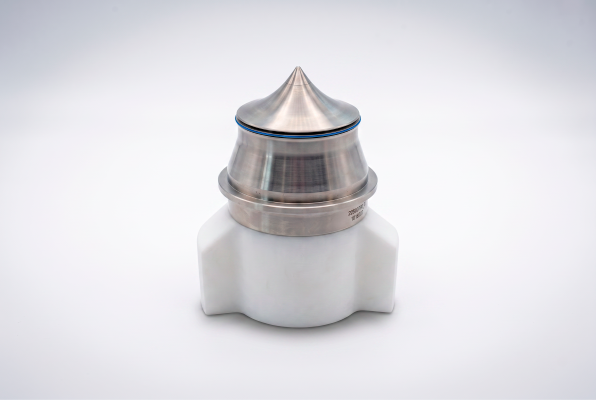
Romaco has introduced the FLEXIJET, a new generation of spray nozzle designed specifically for fluid bed granulation, promising simpler operation, faster cleaning and lower maintenance costs.
The new nozzle is built for short batch cycles and frequent product changes, offering an alternative to Romaco Innojet’s ROTOJET, which remains the preferred solution for complex, long-duration coating processes involving unstable suspensions.
In fluid bed processing, the spray nozzle is critical to both granulation and coating. It injects liquid into the fluidized product, where it must deliver consistent spraying while avoiding blockages and process interruptions.
The FLEXIJET has been designed to make that task considerably easier. Removing the nozzle requires just one screw to be undone, after which it can be dismantled into ten individual parts. Reassembly is equally straightforward, with no need to check or adjust the spray gaps.
A flexible plastic membrane is central to the nozzle’s design. The membrane seals the circular spray gap from above and lifts only under the pressure of the incoming liquid, ensuring uniform distribution even at low spray rates. If spraying is interrupted, the liquid is pumped back, causing the membrane to retract and seal the gap. This helps prevent drying and deposits that could otherwise block the nozzle and jeopardize the next production run.
Maintenance has also been simplified. All nozzle components and wear parts can be reordered and replaced by operators themselves, reducing reliance on specialist expertise and helping keep downtime and servicing costs low.
That marks a sharp contrast with the ROTOJET, a precision-engineered nozzle whose manufacturing tolerances extend across more than 20 components. While the ROTOJET offers capabilities required for demanding coating applications, it also requires considerably more specialist knowledge to operate and maintain.
The ROTOJET continues to be the nozzle of choice for functional coating applications, including the coating of fine starter particles with pharmaceutical ingredients. Such coated micropellets are used, for example, in the production of MUPS tablets.
These coating processes can run for many hours, with production times exceeding 20 hours in some cases. During processing, pellets can increase substantially in both weight and diameter, making precise control essential.
The challenge is even greater when unstable suspensions are used. Such formulations can segregate and sediment during spraying, potentially causing deposits, nozzle blockages and unwanted agglomeration.
The ROTOJET addresses this problem with a rotating nozzle head. Its rotation creates continuous relative movement within the spray gap, keeping the suspension in motion and helping prevent deposits from forming.
For these demanding applications, the ROTOJET’s precision and complexity remain an advantage. For faster, less complex granulation processes, however, Romaco is positioning the FLEXIJET as the more practical choice.
The FLEXIJET was developed as a complementary alternative to the ROTOJET, allowing users to match nozzle technology to the specific requirements of their process.
Romaco Innojet has retained compatible mounting dimensions and identical spray geometry for both technologies. As a result, users can switch between the nozzles while maintaining the same process parameters, without modifying the machine.
Both nozzles are available across the VENTILUS range of fluid bed processors, from laboratory and pilot systems through to full-scale production.
The FLEXIJET can also be used for hot melt coating, where no liquid evaporates and batch times are comparatively short. The patented technology is already in commercial use, including with pharmaceutical manufacturers in Germany and France.
Whether equipped with a FLEXIJET or ROTOJET, every VENTILUS machine uses a single centrally positioned bottom spray nozzle.
The nozzle sits in the centre of the ORBITER booster plate, which introduces process air and promotes uniform flow through the cylindrical process container. Its circular design and overlapping vanes create a controlled donut-shaped product movement, supporting homogeneous spraying and drying.
Both nozzle types use three circular spray gaps positioned one above another. Liquid is sprayed horizontally through the central gap at 360 degrees, while compressed air enters through the upper and lower gaps to atomize the liquid into fine droplets.
Droplet size is controlled by the pressure of the upper and lower air jets and can be tailored to whether the process requires granulation or coating. Once the parameters are established, the same settings can be used regardless of which nozzle technology is installed.