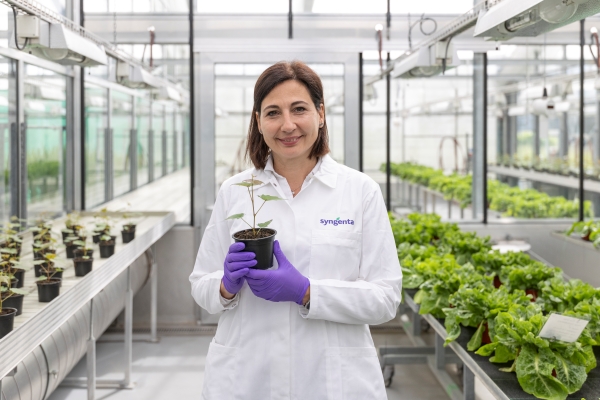
Camilla Corsi, Head of Crop Protection Research & Development at Syngenta, has been named the winner of the prestigious 2026 American Chemical Society (ACS) International Award for Research in Agrochemicals, recognizing her leadership in the discovery of a new generation of crop protection technologies.
The ACS Fall Meeting will host a symposium in Corsi’s honor, highlighting her contributions to the development of several major crop protection innovations, including the fungicide pydiflumetofen (ADEPIDYN technology); the insecticides isocycloseram (PLINAZOLIN technology) and spiropidion (TINIVION technology); and the SDHI (succinate dehydrogenase inhibitor) nematicide cyclobutrifluram (TYMIRIUM technology).
Together, ADEPIDYN, PLINAZOLIN and TYMIRIUM represent a new generation of crop protection technologies designed to deliver disease, pest and nematode control across crops and geographies.
A chemist by training, Corsi joined Syngenta in 2004 and has held a series of leadership positions across Research & Development. She became head of Crop Protection Research & Development in January 2025, taking charge of an organization of more than 3,000 scientists, technologists and regulatory experts across 51 countries and four major research sites.
She was also appointed to Syngenta Group’s extended Global Leadership Team and joined the company’s Innovation Board in January 2025.
“This is a very proud moment for me,” Corsi said. “As a company, we continuously invest in key technologies to ensure agriculture becomes more productive, sustainable and resilient in the face of climate and resource pressures. I would like to thank the American Chemical Society for both recognizing the work we do at Syngenta and honoring me with this award.”
The award comes as Syngenta continues to make major investments in crop protection research. The company spends up to US$ 2 billion annually on R&D across its businesses and is targeting the launch of at least 20 new proprietary innovations in crop protection and biologicals over the next decade.
Developing new crop protection products is a lengthy and highly regulated process. Products must meet stringent safety requirements covering workers, consumers, crops and the environment, with development often taking more than 10 years and costing more than US$ 300 million before commercial launch, according to industry figures.
Syngenta, a global leader in crop protection, is expanding its research beyond synthetic chemical pesticides to include biological solutions derived from or inspired by nature. These technologies aim to control pests, improve nutrient uptake and help crops withstand increasingly challenging climatic conditions.
At the same time, artificial intelligence and digital technologies are accelerating the pace of agricultural innovation. In R&D, machine learning is enabling scientists to explore vast chemical spaces and identify potential new active ingredients far faster than traditional approaches alone. Generative design is also helping researchers develop improved products more efficiently.
In the field, AI-powered detection and agronomic recommendations are supporting precision agriculture, while AI-driven demand forecasting is improving logistics and supply-chain efficiency. The convergence of AI, data and agronomic expertise is reshaping how crops are grown, protected and delivered.
Originally from Italy, Corsi holds a graduate degree in Chemistry from the University of Florence and a PhD from University College London. She also co-sponsors Syngenta’s Women Leading in Science network and advocates for women and girls in STEM and the next generation of female science leaders.