ACWA Power and Veolia are joining forces to squeeze further efficiencies out of seawater desalination, targeting everything from plant design and equipment to chemical use, water quality and day-to-day operations.
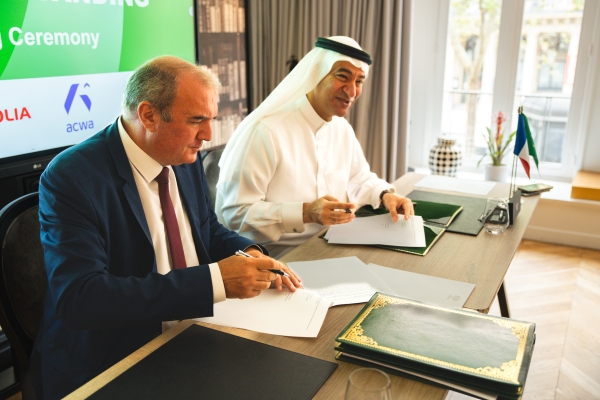
The Saudi-listed water and energy company and French environmental services giant have signed a memorandum of understanding in Paris to establish a joint program aimed at optimizing desalination across the full value chain.
The agreement expands a collaboration between the two companies spanning more than a decade and will initially draw on their combined expertise to improve the performance and efficiency of ACWA’s desalination portfolio.
Energy efficiency sits at the heart of the program. Engineers from both companies will work on plant designs, equipment selection and operating strategies aimed at cutting power consumption.
The companies will also seek to reduce chemical consumption and improve dosing systems, lowering operating costs while limiting environmental impacts.
A third focus will be water quality, with advanced monitoring, treatment methods and real-time assurance protocols designed to strengthen performance while plants are operating.
Veolia’s design expertise and operational best practices will also be applied across ACWA’s existing fleet, with the companies targeting higher efficiency and stronger operational standards.
The agreement also covers project delivery, building on existing cooperation between the companies and creating a framework for closer coordination, faster responses to operational challenges and stronger focus on delivering projects on schedule.
Raad Al-Saady, Managing Director of ACWA, said: “Between Acwa and Veolia, we have built the most efficient desalination plants in the world, and the lesson those projects taught is that the last increments of cost are rarely sitting in one easily identifiable place and are and are rather spread across design, procurement, chemistry and operation. This is why we have written this agreement to cover the whole chain instead of the single stage that happens to be easiest to measure.”
Anne Le Guennec, Director of the Water Technologies Zone, Veolia, said: "Through this agreement, thanks to our advanced water technologies, we are offering concrete and effective solutions to renew and preserve water resources. In Saudi Arabia, environmental security, which we build every day with our partners, depends on our collective ability to preserve every drop of water.
"Here, alongside Acwa, we are accelerating the excellent work carried out for more than 10 years to revolutionize the desalination model, and we continue to put our cutting-edge technologies and expertise at the service of essential infrastructure, competitiveness, and the strategic autonomy of the region."
The potential impact is significant because even tiny efficiency gains can translate into substantial savings when applied across large desalination plants.
ACWA said four of its plants — Rabigh 3, Rabigh 4, Jazlah and Shuaibah 3 — each produce 600,000 cubic meters of water a day. Saving just 0.1 kilowatt-hour per cubic meter at one such facility would cut annual electricity consumption by roughly 22 gigawatt-hours.
The optimization program will also extend beyond Saudi Arabia. The companies plan to apply the same approach to ACWA’s desalination projects in Azerbaijan and Senegal, including the Caspian Sea plant, with capacity of 300,000 cubic meters a day, and the Grand Côte project, designed to produce 400,000 cubic meters a day.
The push comes as Saudi Arabia relies heavily on desalination to meet municipal water demand. With groundwater resources limited and demand continuing to rise, improving the efficiency and cost of seawater desalination is central to the Kingdom’s long-term water strategy and its Vision 2030 ambitions.
ACWA currently operates 4.1 million cubic meters a day of desalination capacity in Saudi Arabia and has a global desalination portfolio totaling 9.7 million cubic meters a day.
The new memorandum does not commit the companies to additional desalination capacity and is non-exclusive. Instead, it establishes a technical work program with designated leads and regular reviews covering existing operations and the development of future seawater reverse osmosis plants.
The companies said the goal is to turn incremental improvements across design, procurement, chemistry and operations into measurable gains at scale — making each successive desalination project more efficient, competitive and sustainable.