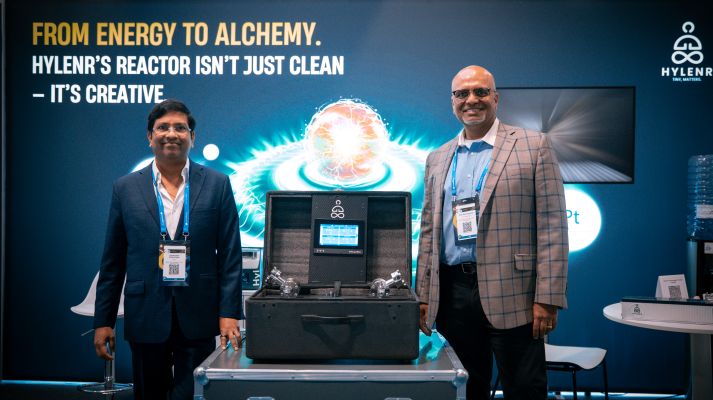
Hyderabad-based deeptech company Hylenr has completed Phase 1 of an independent validation study of its Lattice Confinement Fusion (LCF) technology at Texas A&M University.
This marks a key step in its effort to independently test its lattice-based energy system and advance it toward commercialization.
The study evaluated Hylenr’s BRT-NiUCS-2 reactor, a small modular system using hydrogen-loaded nickel-palladium catalyst materials. Multiple reactors and catalyst samples were prepared and tested under controlled laboratory conditions in the Nuclear Engineering Department at Texas A&M University.
The research, titled “Validation of Anomalous Heat and Nuclear Signatures in the BRT-NiUCS-2 Reactor: Phase 1 LCF Investigation,” examined thermal performance, radiation emissions, residual gas composition and changes in reactor materials following testing.
The Phase 1 paper, co-authored by Hylenr and Texas A&M University, was presented at the 27th International Conference on Condensed Matter Nuclear Science (ICCF-27), held in Niagara Falls, Canada, from August 31 to September 4.
“Our objective has always been to move beyond internal observations and subject the technology to rigorous, independent testing. The validation study conducted at Texas A&M University provides an important external data point across thermal measurements, gas analysis, and material characterization,” said Ram Ramaseshan, Co-Founder and Board Member, Hylenr.
“These results provide a basis for the next phase of validation while reinforcing our focus on reproducibility, quantitative measurement, and scientific transparency.”
Prof. Lin Shao, Professor of Nuclear Engineering at Texas A&M University said, “The Phase 1 research provided an opportunity to examine the BRT-NiUCS-2 reactor using a range of complementary analytical techniques. The combination of thermal measurements, residual gas analysis, nuclear diagnostics and post-reaction materials characterization broadens the experimental basis for assessing the observed phenomena and determining priorities for further investigation.”
One of the study’s principal diagnostics was Residual Gas Analysis (RGA), conducted using an SRS RGA 100 system under high-vacuum conditions. Researchers reported elevated helium, argon and neon signals in the active reactor compared with background measurements. Helium and argon signals were reported at levels approximately two to three orders of magnitude above background.
The study said no corresponding increase in nitrogen was observed, which it reported as evidence against atmospheric leakage being the sole explanation for the measurements.
Thermal testing also produced a difference between the active reactor and the calibration device. Measurements using thermocouples and calibrated infrared imaging showed the active reactor operating at consistently higher temperatures under comparable input-power conditions.
Researchers also reported morphological and compositional changes in catalyst samples after testing, based on scanning electron microscopy and energy-dispersive X-ray spectroscopy (SEM/EDX) analysis.
Radiation monitoring produced a different result. Geiger–Müller and neutron detectors recorded no detectable gamma or X-ray emissions, while neutron counts remained statistically indistinguishable from background during approximately five days of monitoring.
With Phase 1 complete, Hylenr is preparing for Phase 2 of the validation programme. The next stage will focus on multiple independent reactors, quantitative calorimetry and tighter characterization of loading parameters, alongside isotopic-ratio measurements and advanced analytical techniques including SIMS and ICP-MS.
“Hylenr brings together two transformative opportunities in one reactor: clean fusion energy and strategic rare-earth production. Building on the Phase 1 study, we’re moving into the next phase with a focus on scaling the technology and its commercial applications." said Siddhartha Durairajan, Co-founder & Board Member, Hylenr.
The company said the staged validation process is intended to help bridge the gap between laboratory observations and commercial development. Future work will focus on establishing repeatability, quantifying energy output and defining the engineering requirements for scalable systems.