The approval comes under the Support for the Price Gap system established by the Hydrogen Society Promotion Act

Tosoh Corporation, Mitsui & Co, Hokkaido Electric Power, and Mitsubishi UBE Cement have secured certification from Japan’s Ministry of Economy, Trade and Industry (METI) and Ministry of Land, Infrastructure, Transport and Tourism (MLIT) for their low-carbon ammonia business plan.
The approval comes under the Support for the Price Gap system established by the Hydrogen Society Promotion Act.
The initiative, spearheaded by METI’s Agency for Natural Resources and Energy, aims to accelerate the supply and use of low-carbon hydrogen and its derivatives. Over 15 years, the system will provide financial support to bridge the price gap between fossil fuels and low-carbon alternatives.
The certified business plan outlines collaboration between the four companies to establish a low-carbon ammonia supply chain in Japan by fiscal year 2030. Low-carbon ammonia, which produces significantly fewer CO₂ emissions than conventional ammonia, is expected to decarbonize traditional applications in fertilizers and chemical products—and serve as a clean fuel that emits no CO₂ during combustion.
The Hydrogen Society Promotion Act recognizes low-carbon ammonia as a form of low-carbon hydrogen for energy and chemical use.
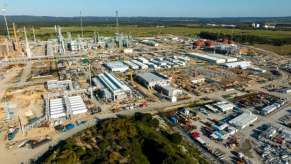
Under the METI- and MLIT-certified plan, Mitsui “will purchase a portion of the low-carbon ammonia produced at CF Industries’ Blue Point Complex in Louisiana, USA, through a joint venture in which Mitsui is an investor and will receive support under Support for the Price Gap.”
Mitsui “will annually supply 280,000 tons of that low-carbon ammonia to Tosoh, Hokkaido Electric Power, Mitsubishi UBE Cement, and other users.” By using this low-carbon ammonia as either fuel or raw material, each user “plans to reduce its environmental impact compared with the use of conventional methods.”
Japan’s first large-scale commercial import of low-carbon ammonia brings together Mitsui, with its extensive experience in producing, transporting, and importing ammonia and energy products, and user companies across power generation, ceramics, and chemicals. Together, the partners “aim to achieve rapid market implementation.”
Subscribe to our newsletter & stay updated.