India’s chemical industry must seize its growing global opportunity by building a stronger, more competitive and sustainable ecosystem, industry and government leaders said at the 61st Annual Awards Presentation Function and 17th Annual Seminar of the Indian Chemical Council (ICC) in Mumbai recently.
The flagship annual gathering of the Indian Chemical Council (ICC), the apex national body representing the Indian chemical industry, brought together senior industry leaders, policymakers, academicians and professionals to celebrate exceptional achievements and deliberate on the forces shaping the future of one of India’s strategically important sectors.
The event was graced by Markus Kamieth, Chairman of the Board of Executive Directors (CEO), BASF SE and President, International Council of Chemical Associations (ICCA), as Chief Guest representing the global chemical industry, and Tejveer Singh, Secretary, Department of Chemicals and Petrochemicals, Ministry of Chemicals and Fertilizers, Government of India, as Chief Guest representing the Government of India.
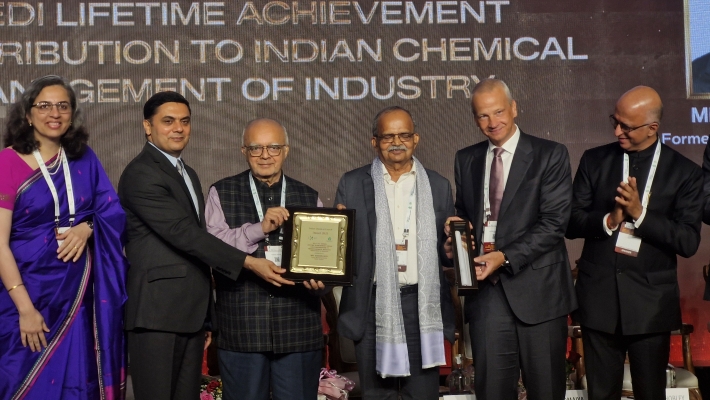
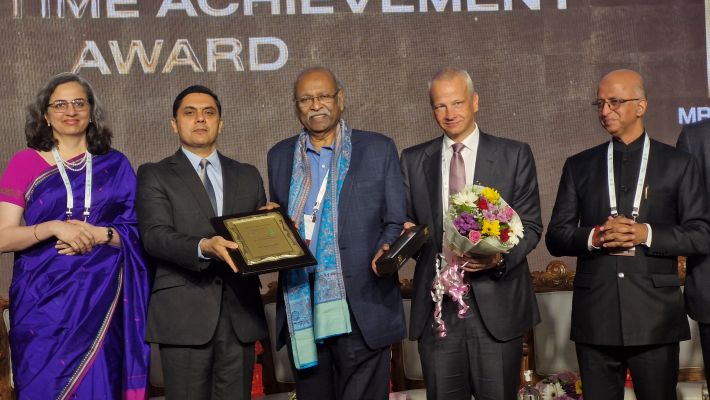
The ICC conferred its prestigious Lifetime Achievement Awards on three distinguished personalities whose contributions have left a lasting mark on India’s chemical sector:
Mukesh Shah, Chairman, Fine Organic Industries Ltd. — ICC Lifetime Achievement Award.
SR Deo, Former Managing Director, NOCIL Ltd. — ICC D. M. Trivedi Lifetime Achievement Award for Management of Industry.
Prof. Ashutosh Sharma, Institute Chair Professor, IIT Kanpur, INAE Visvesvarya Chair Professor & Coordinator, DST Unit on Nanoscience & Center for Environmental Science and Engineering — ICC DM Trivedi Lifetime Achievement Award for Education & Research.
The awards recognised not only individual achievement but also the enduring contribution of leadership, innovation, research and institution-building to the growth of the Indian chemical industry.
Addressing the gathering, Markus Kamieth underlined the importance of collaboration in creating a globally competitive chemical industry. He emphasised that a world-class chemical industry can only be built through strong ecosystems and partnerships spanning industry, government, academia, researchers, suppliers and start-ups.
Highlighting India’s growing strategic importance, Kamieth pointed to the country’s skilled workforce, expanding economy, strong domestic demand and significant manufacturing potential. He noted that India has a unique opportunity to build industrial strength and sustainability simultaneously.
He stressed that competitiveness and sustainability must be pursued as integrated priorities, with energy efficiency, circularity, low emissions, water stewardship, digital manufacturing, artificial intelligence and advanced technologies becoming central to the sector’s future growth.
Kamieth also underscored the need for predictable policies, world-class infrastructure, innovation, investment and deeper industry–academia collaboration to create a globally competitive manufacturing, innovation and export ecosystem.
Expressing confidence in India’s trajectory, he said the country has the potential to emerge as a major global chemical and manufacturing hub, while welcoming the government’s focus on strengthening the chemical sector as a critical driver of the developed India vision.
Tejveer Singh highlighted the chemical industry’s role as a strategic pillar of the Indian economy, noting that the sector contributes over 8% to India’s gross value addition and possesses considerable potential to increase its share in global markets.
Calling for a coordinated approach involving industry, government, investors, R&D institutions and skilled manpower, Singh outlined several priorities for the sector, including a long-term strategy, greater self-reliance, increased investment in R&D, improved infrastructure, lower production costs, development of skilled manpower, streamlined approvals and stronger responses to global trade challenges.
He also highlighted recent government initiatives, including the approval of three dedicated chemical parks under the “Bhavya Rasayan” scheme and efforts to bring chemicals and petrochemicals within the ambit of the RDI scheme.
With sustainability and the green transition becoming increasingly critical to global competitiveness, Shri Singh urged the industry to adopt cleaner and greener practices, leverage available support for carbon capture and utilisation, and build globally competitive value chains.
He reaffirmed the Government of India’s commitment to supporting the continued growth and transformation of the chemical sector.
The event also marked a significant transition in the leadership of the ICC.
Ramya Bharathram, Outgoing President, Indian Chemical Council and Managing Director & CFO, Thirumalai Chemicals Limited, delivered the Welcome Address and introduced the theme of the seminar.
Later, Bharathram passed the presidential mantle to Samir S. Somaiya, Chairman & Managing Director, Godavari Biorefineries Ltd., marking the beginning of a new chapter for the Council.
In his concluding remarks, the new President acknowledged the responsibility entrusted to him and pledged to build on the strong foundation established by his predecessors. He committed to taking the Council towards greater heights, with a focus on advocacy, stronger member engagement and advancing the sustainable and responsible growth of the industry.