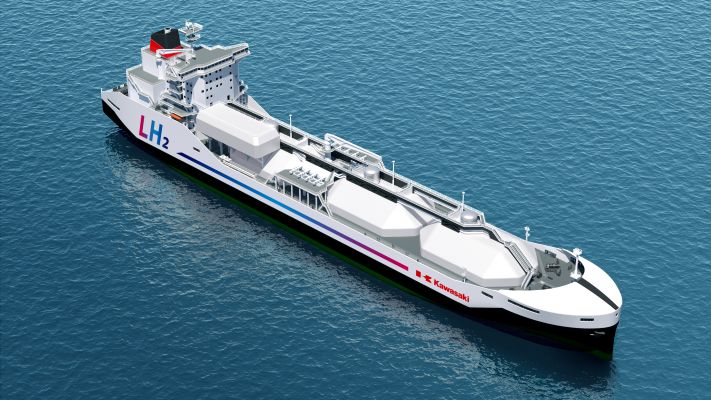
Yokogawa Electric Corporation has received orders from Kawasaki Heavy Industries, Ltd. to supply integrated automation systems for a 40,000 m³ liquefied hydrogen carrier, set to become the world’s largest vessel of its type, as well as two hydrogen-fueled vessels.
The orders position Yokogawa to support the development of Japan’s emerging hydrogen supply chain, providing monitoring and control solutions for the safe storage, transportation and use of hydrogen.
With hydrogen adoption accelerating, the ability to safely transport and store large volumes of the fuel is becoming increasingly important. Liquefied hydrogen is expected to play a central role in building that supply chain, while the use of hydrogen as a maritime fuel is also gaining momentum.
In Japan, demonstration projects spanning the hydrogen supply chain are underway as the country works toward the commercialization of liquefied hydrogen.
For the 40,000 m³ liquefied hydrogen carrier, Yokogawa will provide an integrated system for monitoring and controlling onboard equipment, including emergency shutdown functions. The system is designed to support the safe and efficient handling of liquefied hydrogen, which must be transported at extremely low temperatures.
Yokogawa said the system’s integrated control capabilities are also expected to enhance equipment performance and reduce crew workload over the vessel’s lifecycle, while supporting safe and reliable operations.
The company has separately received an order to supply integrated automation systems for marine hydrogen fuel systems (MHFS) to be installed on the two hydrogen-fueled vessels.
An MHFS comprises liquefied hydrogen tanks and fuel supply equipment and is considered a key technology in the development of hydrogen-powered shipping and the wider push to decarbonize maritime transport.
The vessels are being built under a Green Innovation Fund project led by Japan’s New Energy and Industrial Technology Development Organization (NEDO). The project is aimed at enabling safe, large-scale maritime transportation while helping establish the infrastructure needed for a liquefied hydrogen supply chain.