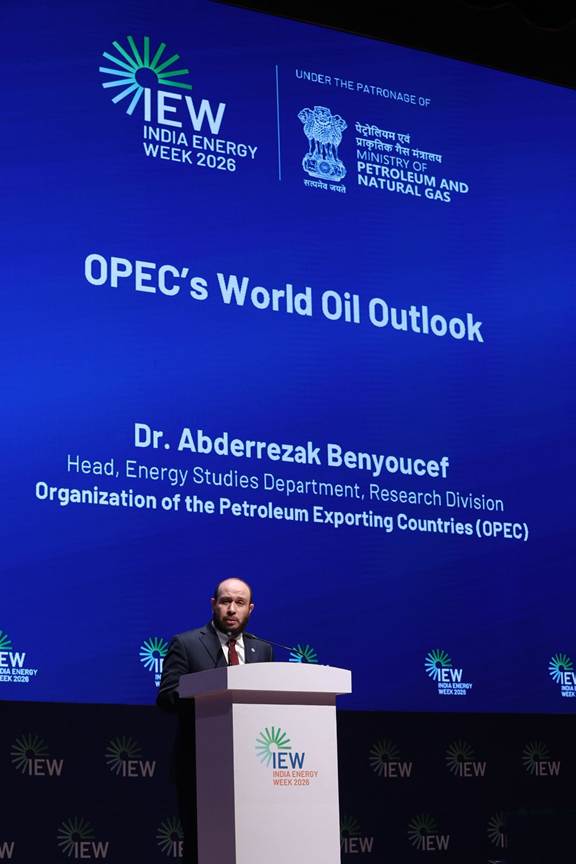
India is poised to become the world’s largest contributor to global oil demand growth through 2050, according to the World Oil Outlook 2025, presented at India Energy Week 2026.
Speaking at the event in Goa, Abderrezak Benyoucef, Head of the Energy Studies Department at OPEC, said, “India alone is expected to add 8.2 million barrels per day of oil demand by 2050.” He highlighted that this surge will be driven primarily by transportation, petrochemicals, and industrial activity.
The report predicts global oil demand will continue rising over the medium and long term, reaching nearly 123 million barrels per day by 2050, with growth concentrated in non-OECD regions.
Benyoucef added that India is projected to be the “largest and most stable contributor to global primary energy demand growth,” with total primary energy demand expected to nearly double from 22 million barrels of oil equivalent per day in 2024 to 43.6 million by 2050.
Globally, primary energy demand is set to climb 23% over the same period, from 308 million to 378 million barrels of oil equivalent per day, with non-OECD countries accounting for nearly 72% of total demand by 2050.
Economic trends reinforce India’s growing energy influence. The OECD report projects India as the “world’s fastest-growing major economy,” with average annual GDP growth of 5.8% between 2024 and 2050. India’s share of global GDP is expected to jump from 8% to 17% in the same period, significantly shaping global energy markets.
Demographics are also a key factor. “India, already the world’s most populous country, will continue to anchor global population growth and rising energy consumption,” the report notes. Global population is expected to grow by 1.5 billion by 2050, mostly in non-OECD countries, alongside increasing urbanisation and improving living standards.
The Outlook stresses the urgency of investment to meet rising energy needs. Cumulative oil-related investment requirements are estimated at USD 18.2 trillion between 2025 and 2050, including nearly USD 15 trillion for upstream development.