In a landmark move to accelerate India’s startup ecosystem, the government has relaxed the mandatory three-year existence requirement for deep-tech startups seeking recognition under the Department of Scientific and Industrial Research’s (DSIR) Industrial Research and Development Promotion Program.
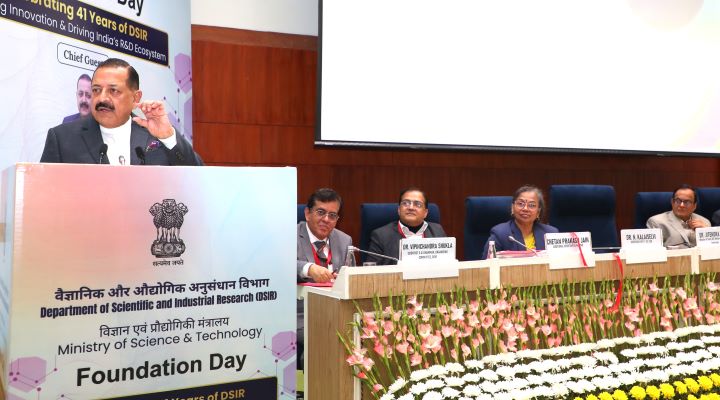
Addressing the 42nd DSIR Foundation Day celebrations, Union Minister of State (Independent Charge) for Science & Technology, Jitendra Singh, said the reform will provide “early momentum to early starters or beginners of StartUp projects as well as promising innovators and entrepreneurs.”
Explaining the rationale, the Minister said, “For early-stage innovators or Startups, a wide basket of schemes already exists across departments such as DST, CSIR, TDB and others. The removal of the three-year existence requirement is a significant incentive to help deep-tech startups scale faster, even before they are fully on their own.”
He added, “That requirement has now been done away with,” referring to previous CSIR rules requiring startups to demonstrate sustainability over three years to access loans and support up to Rs.1 crore. The Minister described the move as a “major incentive with a noble intent to accelerate and sustain new deep-tech startups even before they are fully established on their own, while continuing to maintain appropriate evaluation standards linked to technological maturity.”
Singh also highlighted the symbiotic relationship between DSIR and CSIR, calling it an “intergenerational symbiosis” that has strengthened India’s innovation ecosystem. Drawing a comparison to a joint family, he noted that DSIR emerged from CSIR, but today both institutions complement each other through technology transfers, MoUs, and industry partnerships.
India’s growing global influence in science and technology was another highlight. “We are not only self-reliant; we are making others rely on us,” the Minister declared, citing India’s progress in vaccines, medical devices, and indigenous technologies.
Speaking on DSIR’s role in industry collaboration, he said, “Meaningful research cannot be sustained without industry as an early and essential partner,” noting that DSIR’s fiscal incentives, including customs duty exemptions, now make R&D collaboration more attractive to startups and MSMEs.
Singh also highlighted women’s participation, revealing that over 10,000 women beneficiaries, including more than 55 women-led Self-Help Groups, are availing DSIR schemes—a “healthy and irreversible shift in India’s innovation culture.”
The Foundation Day also saw the launch of four key initiatives: DSIR guidelines for recognition of in-house R&D centres of deep-tech startups, incorporating the relaxed three-year rule; PRISM Network Platform – TOCIC Innovator Pulse, to strengthen innovation pipelines; Creative India 2025 under the PRISM scheme to promote innovation-led entrepreneurship; anc DSIR Disaster Management Plan to bolster resilience and preparedness.
Several MoUs were signed, including the establishment of a Skill Satellite Centre at Dhamtari, Chhattisgarh, in collaboration with NIT Raipur, focusing on technology-led skill development for rural women. Transfer of Technology agreements under the CRTDH programme were also inked, strengthening MSME-focused R&D infrastructure nationwide.
N Kalaiselvi, Secretary, DSIR, praised the department’s role in recognizing in-house R&D units and bridging government, academia, and industry. “DSIR’s unique structure…has enabled it to serve as a vital bridge,” she said, expressing satisfaction at the scale of the Foundation Day celebrations.
Prof Ajay Kumar Sood, Principal Scientific Advisor to the Government of India, stressed the importance of technology sovereignty and scaling lab breakthroughs to market, highlighting tools like the National Technology Readiness Assessment Framework, Manthan, and Uthaan to foster innovation across Tier-II and Tier-III institutions.
Concluding the event, Singh reaffirmed DSIR’s alignment with national missions in energy transition, semiconductors, AI, robotics, and space. “This Foundation Day is not just a celebration of the past, but a decisive step towards building a future-ready, technology-sovereign India,” he said.