India's vision for green supply chains is centred on achieving net-zero emissions by 2070

Green Supply Chain Management (GSCM) means the entire supply chain should be environmentally friendly, from designing the product and sourcing materials to manufacturing, distribution, and handling the product's end-of-life. It aims to minimize waste, reduce pollution, conserve resources, and lower the overall ecological footprint of products and process.
Benefits of GSCM will be cost savings through increased efficiency, better resource management, and can improve a company's brand image and customer loyalty.
Green Supply Chain Management (GSCM) in the chemical industry
GSCM in chemical industry will play major role integrating environment with the entire supply chain to reduce ecological impact, enhance sustainability, and improve efficiency. Key aspects include adopting sustainable materials, green logistics through alternative fuels and efficient transportation, implementing waste management and recycling programs, engaging suppliers in environmental initiatives, and conducting life cycle assessments (LCAs) to understand a product's full environmental footprint from raw material to disposal.
The goal is to achieve a more resilient supply chain that meets environmental, social, and economic criteria, driven by increasing global demand for greener products and the industry's social and environmental responsibilities.
GSCM principle - Reduce, Reuse, Recycle, Reclaim and Degradable.
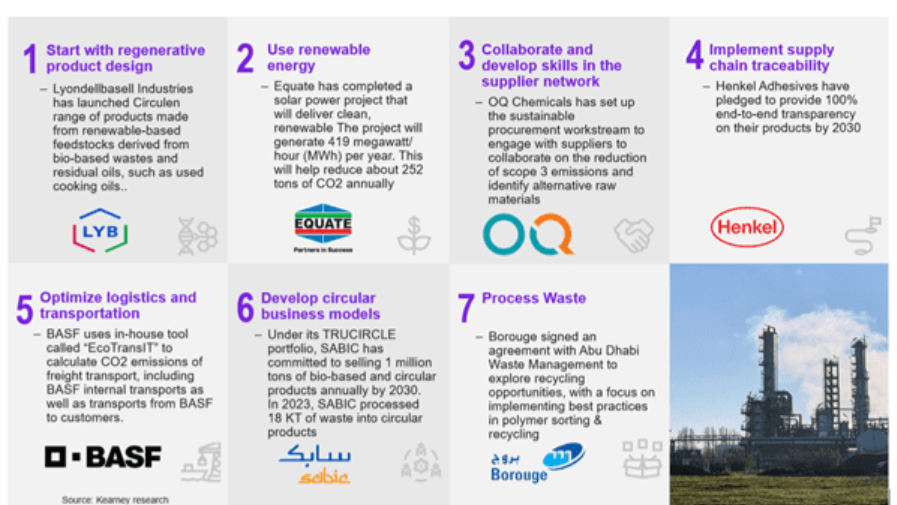
Use renewable energy
Fossil fuel is the primary source of energy for chemical production. Implementing electrically heated chemical processes or reusing process heat, where applicable, can significantly reduce GHG emissions, especially when electricity is produced from renewable sources. Green supply chains can deploy long-term Power purchase agreements with renewable electricity producers (hydropower, wind, solar, etc.). Countries in the Middle East have already taken decisive steps to transition to clean energy that will change the energy mix of the chemical industry, e.g., Saudi Arabia aims to supply 50% of electricity from renewables by 2030.
Start with regenerative product design
The chemical industry would need to prioritize sustainability gains and rethink product design with a sustainability lens. Product & Packaging shall be designed which are easier to reuse or recycle.
Collaborate and develop skills in the supplier network
Suppliers need to be educated, and they need to understand the company’s sustainability goals. All key suppliers will need training and support to develop the mindset required to implement circularity principles. Suppliers can commit to well-aligned science-based sustainability targets and be onboarded to implement circularity principles (reduce, reuse, and recycle).
Implement supply chain traceability
Traceability in material inputs is vital for tracking products during and after their useful life. Information about the chemical composition of the final products in the value chain can be made available to waste management services and material recyclers. Traceability data can be recorded at each stage. Technological innovations such as product passports, blockchains, watermarks, QR codes, AI, and IoT can help gather data as the material moves through the value chain and serve circular business models by facilitating repair and reuse.
Optimize logistics and transportation
Companies can apply GHG emissions as one of the optimization parameters, along with cost and service levels, while designing logistics and distribution networks. Road transportation fleets can be transitioned to green fuels. The chemical industry can influence the transition of marine transportation fleets to dual-fuel fleets and, in the long term, move towards low-carbon fuels with a significant share of green methanol or ammonia, making marine shipping strategies more future-proof. Companies can provide / can emphasis there manpower to use green fuel vehicles and even for transporting factory labour.
Develop circular business models
Circular business models address inefficiencies or waste streams and convert them into business opportunities. Supply chain assets and capabilities can be designed to implement these circular strategies.
Process waste
A green supply chain enhances the opportunities to reuse, refurbish, remanufacture, and—at least—recycle at the end of the product’s life. Chemical companies can reduce the waste generated on-site and, where possible, reuse it by mixing it with virgin feedstock. Non-hazardous waste that cannot be recycled can be used to generate steam for electricity production. Green chemical supply chains can invest in improving waste segregation, recycling, and waste collection and management systems.
Various companies are moving ahead with green supply chain implementations.
Challenges of implementing GSCM
Going Forward
Green supply chain practices will minimize the impact on the environment and help mitigate the risks of climate change. In the long term, they can help lower a company’s operating costs and create a distinct competitive advantage. Chemical companies can fast-track the adoption of the ongoing transition to renewable energy and green fuels (hydrogen, green ammonia, etc.)
India's vision for green supply chains is centred on achieving net-zero emissions by 2070, reducing emissions intensity by 45% by 2030, and building a sustainable and resilient future.
Subscribe to our newsletter & stay updated.