Toray Industries has developed a breakthrough technology that dramatically reduces optical retardation in biaxially oriented polyester film, cutting it to industry-leading levels and potentially overcoming a major barrier to its use in display applications.
The new technology brings head-on optical retardation down to 200 nanometers or less — just one-tenth of the level found in films manufactured using conventional technology. It also reduces thickness-direction retardation and delivers greater uniformity across the film width.
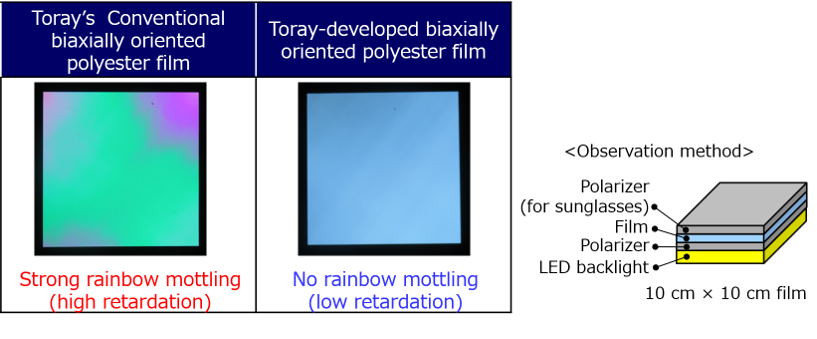
The development could significantly expand the application of polyester film in display surfaces, where its use has been restricted by a persistent optical problem: rainbow-like mottling that appears when screens are viewed through polarized filters, including sunglasses.
Biaxially oriented polyester film is widely valued for its high strength, dimensional stability and excellent processability. These properties make it suitable for packaging, industrial materials and electronic components. However, its adoption in display applications has been limited by optical retardation.
The problem stems from the stretching process used to strengthen and stabilize the film. While essential to achieving the material's mechanical properties, stretching increases optical retardation. Variations in stretching across wider films further complicate efforts to maintain consistent optical performance.
Toray says it has overcome these challenges by refining its biaxial stretching process and developing a proprietary multilayer structure featuring a specially engineered low-retardation polyester layer.
The combination of these advances has brought optical retardation down to 200 nanometers or less when viewed head-on, while also reducing retardation through the film's thickness. The result is a significant suppression of rainbow mottling across different viewing angles, alongside improved optical uniformity across wide films.
The company said the technology addresses key limitations of conventional biaxially oriented polyester film. It will now work on developing the technology for mass production.
Beyond its optical performance, Toray's new film combines low retardation with low moisture permeability and resistance to repeated bending — a combination that has been difficult to achieve with conventional optical films for displays.
These characteristics could make the material particularly attractive for displays that require dimensional stability under changing humidity conditions and durability under repeated flexing. It also holds potential for components used in sensors that rely on polarized light.
Toray said it will continue developing materials and production technologies that maximise the inherent advantages of polyester film, as part of its commitment to creating new value and contributing to social progress.