The government announced a scheme to support states in establishing three dedicated Chemical Parks using a cluster-based "plug-and-play" model
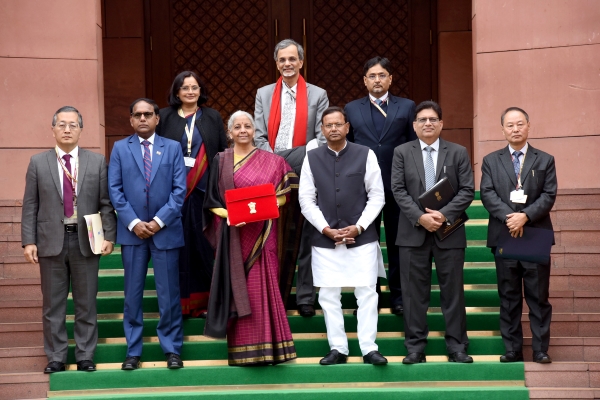
The chemical industry has broadly welcomed the Union Budget 2026-27, citing its focus on strengthening domestic manufacturing, reducing import dependency, and promoting sustainable industrial practices. Industry leaders noted that the budget reinforces India's ambition to become a globally competitive production hub through targeted infrastructure and fiscal reforms.
Dedicated Chemical Parks: The government announced a scheme to support states in establishing three dedicated Chemical Parks using a cluster-based "plug-and-play" model. These parks are allotted Rs. 600 crore in FY27 to enhance domestic production and improve infrastructure.
Decarbonisation Push: The chemical sector was identified as a key industry for the implementation of Carbon Capture, Utilisation, and Storage (CCUS) technologies. A total outlay of Rs. 20,000 crore over five years was proposed for CCUS to help "hard-to-abate" sectors meet climate goals.
Customs Duty Rationalisation:
Potassium Hydroxide: Basic Customs Duty (BCD) was increased from Nil to 7.5%, effective February 2, 2026, to protect domestic manufacturers.
Lapsing Exemptions: Several exemptions will lapse on April 1, 2026, including those for Naphtha (used in fertilizer manufacturing), Alpha Pinene, and certain catalysts.
Infrastructure & Logistics: The budget's Rs. 12.2 lakh crore capital expenditure target and the development of new dedicated freight corridors are expected to significantly reduce logistics costs for the industry.
Biopharma Shakti: A Rs. 10,000 crore outlay for the biopharmaceutical sector over five years was introduced to position India as a global biologics hub.
Samir Somaiya, CMD, Godavari Biorefineries
"We welcome the emphasis on Carbon Capture and Storage and BioCNG. These reflect the continuing importance on towards moving towards a lower carbon footprint and moving towards a net zero as per the Prime Minister’s commitment of India achieving net zero status by 2070.”
Dr. P.S. Gahlaut, Managing Director, Indian Potash Limited
"In order to increase crop production, the country needs to significantly increase farm mechanisation and adopt modern farming techniques. In this regard, the announcement of establishing Bharat-VISTAAR (Virtually Integrated System to Access Agricultural Resources), a multilingual AI tool which would integrate the AgriStack portals and the ICAR package on agricultural practices with AI systems, is a timely move. It is expected to promote deployment of precision farming technologies across geographies and crops, thus allowing farmers to make informed decisions, which in turn would help enhance crop yield and nutrition by promoting optimum utilisation of resources such as water, fertilizers and other agro-chemicals.
Further, the announcement of a Credit-Linked Subsidy Programme for Animal Husbandry sector in the budget 2026-27 is a step in the right direction. The likely creation of livestock, dairy and poultry-focused integrated-value chains, and Livestock Farmer Producers Organisations, is expected to empower the next generation of rural livestock owners, which may emerge as a sustainable sources of employment and high-growth business opportunities."
Vishal Sharma, Executive Director and Chief Executive Officer, Godrej Industries (Chemicals)
“Budget 2026-27 ramps up the government’s push to make Indian manufacturing stand out, and for the chemicals sector, it’s a strong step forward.
The reforms around extra funding for R&D is big for chemical sector where progress depends on constant innovation, especially in advanced materials, specialty chemicals, and fresh sustainable solutions.
While the budget lays out a clear strategy, the industry would have welcomed stronger fiscal incentives for capital-heavy green tech, quicker clarity on the new labour codes, and more focused support for exports. Moves like these would help chemical companies attract more investment and compete faster on the global stage. Still, the ‘Reform Express’ narrative inspires confidence and provides a solid platform for sustainable, technology-driven manufacturing growth in India.”
Abhishek Shrivastava, MD, IMEA, The Lubrizol Corporation
“The Union Budget 2026–27 sends a strong and timely signal for India’s industrial growth journey. The unmissable focus on domestic manufacturing is reflected through continued support for production ecosystems, infrastructure expansion, and skill development, which will significantly help elevate Indian manufacturing to global standards. For the chemical industry, the government’s commitment to rationalising and lowering customs duties on chemical raw materials is particularly important, as it will help reduce costs, strengthen supply chains, and enable Indian manufacturers to compete more equitably at the global level.
Additionally, the focus on logistics and innovation-led growth further reinforces confidence in long-term investments across sectors. The Budget’s balanced approach, addressing structural bottlenecks while promoting higher value-added manufacturing supports sustainable growth and resilience. The recent clarity on the GST intermediary ruling also brings much-needed certainty for cross- border services, aiding ease of doing business. Overall, this is a forward-looking budget that aligns industry aspirations with the larger goal of sustainable nation building. Timely and effective execution of the announced measures will be key to unlocking their full impact on businesses and the economy.”
S. Sunil Kumar, Country President, Henkel Adhesives Technologies India
“We welcome Union Budget 2026 and its focus on the three Kartavyas of accelerating growth, building national capacity, and ensuring inclusive development. The continued emphasis on infrastructure is reflected in the Rs. 12.2 lakh crore public capital expenditure. Investments in transport corridors, urban infrastructure, capital goods, electronics manufacturing, and semiconductors signal a clear intent to build deeper, more resilient manufacturing capabilities. For the adhesives sector, this supports demand across infrastructure-led and technology-intensive applications. These range from infrastructure and transportation to electronics and semiconductor manufacturing, where performance, durability, and reliability are critical.
Henkel’s strategic focus on innovation, digitalisation, and sustainability is well reflected in the Budget’s emphasis on sustainability, digital manufacturing, advanced electronics, and Semiconductor Mission 2.0. The Rs. 20,000 crore allocation for carbon capture and utilisation further signals that sustainability is being treated as an economic enabler rather than a compliance requirement. Taken together, the Budget underscores a responsible growth framework anchored in inclusivity, capability building and long-term competitiveness, and we would like to credit the government for this.”
Dhiren Jatakia, Head – Accounts & Finance, Covestro India
“We welcome the government’s focus on strengthening domestic manufacturing, particularly in the chemicals sector. Initiatives like chemical parks and cluster-based infrastructure will help scale production, strengthen supply chains, and create opportunities for local businesses. Support for industrial and logistics infrastructure, along with simplified compliance, will enable manufacturers to grow and innovate.
We also value the emphasis on sustainability, energy transition, and carbon capture technologies, which aligns with Covestro India’s commitment to responsible growth and advanced materials for a greener future. These measures lay a strong foundation for innovation, reduced import dependence, and a competitive, resilient chemical industry in India.”
Amitt Nenwani, MD, Shivtek Spechemi Industries
“The Union Budget 2026 has provided a definitive blueprint for India’s transition from a chemical consumer to a chemical powerhouse. The Finance Minister’s announcement of three dedicated chemical parks is a masterstroke in de-risking global supply chains and fostering a ‘plug-and-play’ ecosystem for specialty chemicals.
The government's focus on ISM 2.0 and rare-earth corridors further underscores the need for a robust domestic specialty chemical supply chain. I can humbly state that 'Aatmanirbharta' is now meeting industry action. With these new chemical corridors, we expect a significant reduction in logistics costs and a massive surge in R&D-led manufacturing, positioning India as the primary 'Plus One' for the global specialty chemicals market.”
Vineet Agarwal, Managing Director, Transport Corporation of India
“The Union Budget 2026–27 sends a strong and reassuring signal on India’s manufacturing-led growth agenda. By maintaining fiscal discipline with a deficit of 4.3% while scaling capital expenditure to Rs. 12.2 lakh crore, the government has reinforced confidence in long-term investments, capacity creation, and a stable, predictable policy environment that strengthens ease of doing business.
The budget’s sharp focus on logistics and industrial infrastructure will be a major enabler of manufacturing scale-up. Dedicated freight corridors, expansion of national waterways, high-speed rail connectivity, investments in ship-repair ecosystems, and a Rs. 10,000-crore push for container manufacturing will significantly reduce logistics costs and build a robust ecosystem for capital goods and supporting industries. These measures will strengthen MSMEs, crowd in private investment, and generate large-scale employment across manufacturing, logistics, and tourism-linked services.
Equally important is the forward-looking emphasis on advanced manufacturing through ISM 2.0, semiconductors, data centres, and AI-led digital platforms. Together, these initiatives lay the foundation for resilient, technology-driven supply chains and position India as a globally competitive hub for manufacturing, trade, tourism, and job creation—aligned with the broader vision of Viksit Bharat.”
Sheetal Sharad, Chief Ratings Officer, ICRA ESG Ratings
“The Budget builds on India’s sustainability agenda. Expanding transportation corridors with a focus on sustainable logistics strengthens supply‑chain sufficiency and supports climate mitigation. The Rs. 20,000 crore allocation for CCUS encourages low‑carbon technology adoption in hard‑to‑abate sectors. Customs duty exemptions in clean‑energy areas including battery storage components, solar inputs and nuclear projects, would help speed up the transition. The planned restructuring of key power‑sector lending institutions may influence how climate finance flows to the energy transition, making it important to watch. MSME‑focused reforms support indigenous capability building and value chain strengthening, while initiatives for persons with disabilities and women‑led enterprises promote inclusive and sustainable growth.”
Ankit Jain, Vice President & Co Group Head - Corporate Ratings, ICRA
“The Union Budget continued its focus on clean energy with measures such as exemption of the basic custom duty (BCD) for capital goods for manufacturing Lithium-ion cells for batteries as well as battery energy storage systems (BESS). Further, budget also provides BCD exemptions on import of goods required for all nuclear power plants till 2035. Both these measures can aid in the tariff competitiveness of BESS as well as nuclear power projects in India. Further, increased allocation on PM Surya Ghar Muft Bijli Yojana and continued focus on PM Kisan Urja Suraksha evam Utthaan Mahabhiyan will support the renewable capacity addition in the country. Additionally, the tax relief towards data center investments for foreign entities providing cloud servicing from India is likely aid the renewable capacity addition, given the sustainability focus.”
Rupal Gupta, Founder, Managing Director & CEO, TrueRE Oriana Power
“Budget 2026–27 marks an important inflection point in India’s energy transition by formally recognising that decarbonisation cannot rely on renewable power alone but must also address emissions from hard-to-abate sectors through credible carbon management solutions.
The proposed Rs. 20,000 crore multi-year outlay for Carbon Capture, Utilisation and Storage (CCUS) is a significant and timely intervention. It signals a shift from viewing carbon purely as a liability to treating it as a managed resource, particularly for sectors such as power, cement, steel, and refining. If implemented through cluster-based deployment and clear utilisation pathways, CCUS can become a foundational pillar of India’s industrial decarbonisation strategy rather than a niche technology experiment.
Equally important are the Budget’s enabling measures that strengthen the surrounding ecosystem. Customs duty rationalisation for lithium-ion cells used in battery energy storage systems, along with support for critical solar and wind manufacturing inputs, will help improve grid stability and cost competitiveness as renewable penetration deepens. The proposed restructuring of PFC and REC to improve credit velocity can further ease financing constraints for large, long-gestation clean energy projects.
However, to fully unlock private capital at scale, sharper execution frameworks are still needed, particularly around payment security for renewable PPAs and clarity on how CCUS projects will be contracted, certified and monetised. Clear standards for measurement, reporting and long-term offtake will be critical to making CCUS bankable.
Also, a clearer demand-side support for green hydrogen will be critical to accelerate large-scale deployment of green hydrogen and clean fuels. Overall, this Budget reflects a maturing energy policy lens, one that balances renewables, storage and manufacturing with carbon management.”
Yashodhan Ramteke, CEO & Director, EcoGuard Global
“With the Union Budget announcing a commitment of Rs. 20,000 crores over five years to Carbon Capture, Utilisation and Storage (CCUS), we see a major shift in the way the country is planning to address the challenge of decarbonisation in sectors such as power, steel, cement, refineries, and chemicals. The scheme has the potential to take CCUS from the pilot stage to a viable industrial solution, which would be beneficial in reducing transition risk in the country’s journey towards the development of its domestic carbon market. Post the renewable energy push that resulted in achieving our NDC targets earlier than anticipated, the next focus area naturally flows into CCUS which will help the country to decarbonize its hard to abate sectors.
This move also provides a strong base to the green economy of the country by allowing the reduction of emissions without impacting the level of industrial output, which is critical to maintaining the country’s global competitiveness. With the country increasingly aligning itself to the European Union’s carbon standards, investments in CCUS, MRV technologies, and outcome-based incentives would make the country’s industry not only ‘decarbonisation-ready’ but also ‘market-aligned,’ which would be critical to the country’s Net Zero ambitions.”
Manoj Kumar Jhawar, Chairman and Managing Director, PTC India
"Union Budget 2026-27 is a visionary blueprint which has shifted the needle from “capacity addition” to “systemic resilience”. As India accelerates towards its goal of Viksit Bharat by 2047, the Budget has set the tone for the next phase of energy transition, which not merely depends on generating green power, but in our ability to store, transmit and trade it efficiently.
By exempting basic custom duty for capital goods for manufacturing Lithium-ion cells for batteries and battery energy storage systems (BESS), the government has paved the way for round-the-clock renewables, effectively transforming intermittent green energy into firm, dispatchable power. This will significantly deepen the power markets and allow traders like PTC to offer more reliable renewable solutions to utilities and C&I consumers."
Subscribe to our newsletter & stay updated.