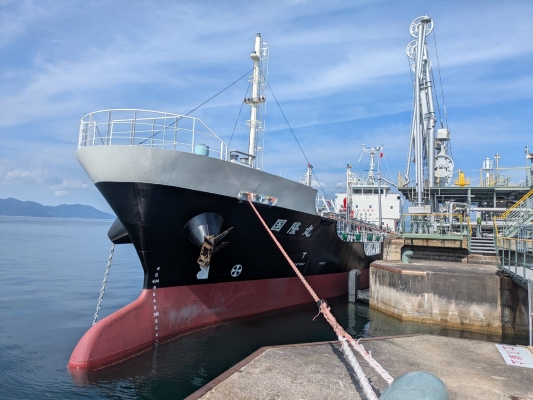
Japan has taken a significant step towards decarbonising coastal shipping with the completion of the chemical tanker Kokuryu Maru and the successful delivery of its first methanol fuel supply, marking a milestone in the adoption of alternative marine fuels.
Mitsubishi Gas Chemical Company (MGC), Kokuka Sangyo Co., Ltd. and Hanshin Diesel Works, Ltd. announced that the 498-gross-tonne vessel, equipped with a dedicated methanol-fuelled main engine manufactured by Hanshin Diesel Works, has been completed. The engine was ordered by Kokuka Sangyo.
Chartered by MGC, the vessel is expected to primarily transport methanol within Japan while also operating as a methanol bunkering vessel, supplying fuel to other ships. It is Kokuka Sangyo’s first vessel powered exclusively by methanol.
The vessel received its first methanol bunkering at Kinoe Port on September 24, 2026. The fuel supply included biomethanol produced domestically at MGC’s Niigata Plant, which will be used to power the vessel during operations.
The project comes as Japan intensifies efforts to reduce greenhouse gas emissions from domestic coastal shipping. The Ministry of Land, Infrastructure, Transport and Tourism has set targets to cut CO2 emissions from the sector by approximately 17% by FY2030 and 36% by FY2040, compared with FY2013 levels.
Methanol is emerging as a potential alternative to conventional marine fuels because it can be stored and handled as a liquid at ambient temperature and pressure, making it compatible with much of the existing fuel-handling infrastructure. It can also reduce emissions of sulfur oxides (SOX), particulate matter (PM) and nitrogen oxides (NOX) compared with conventional fuels.
The Kokuryu Maru project has been selected for a Japanese government programme supporting decarbonisation in the maritime sector, including the introduction of LNG and methanol fuel systems.
By operating on methanol, the vessel is expected to reduce CO2 emissions by approximately 17.5% compared with a ship running on conventional heavy fuel oil.
The inclusion of domestically produced biomethanol in the vessel’s first fuel supply highlights the companies’ broader push to expand the use of lower-environmental-impact fuels in shipping.
Methanol can be produced from a range of sources, including CO2, waste plastics and biomass. MGC is advancing its Carbopath environmental circulation platform, which aims to create materials and energy from methanol produced through these routes, supporting the transition towards a circular economy.
Kokuka Sangyo is working to strengthen its shipping decarbonisation efforts by developing an integrated system covering methanol transportation and bunkering. Hanshin Diesel Works, meanwhile, has pursued methanol engine technology for years, recognising the fuel’s potential as a cleaner alternative and moving early towards commercialisation.
The completion of the Kokuryu Maru and its first methanol bunkering mark a practical step towards deploying alternative fuels in Japan’s coastal shipping sector.
The three companies said they would continue working through the vessel’s operation to expand methanol fuel adoption and establish a reliable supply framework, contributing to the maritime sector’s broader carbon-neutrality goals.