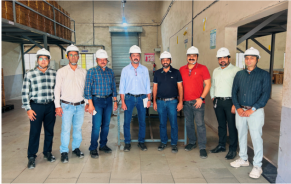
Idemitsu Kosan, together with the City of Yokohama, Kokuka Sangyo Co, Mitsui O.S.K. Lines, and Mitsubishi Gas Chemical Company —collectively the “Five Parties”—have successfully carried out Japan’s first ship-to-ship bunkering of methanol at anchorage.
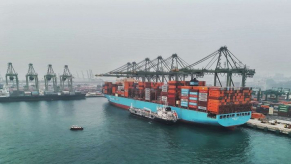
Methanol fuel was transferred from the coastal transport vessel Eika Maru, operated by Kokuka Sangyo, to the dual-fuel ocean-going vessel Kohzan Maru VII, operated by MOL. Both ships are chartered by MGC. The operation also used domestically produced biomethanol from MGC’s Niigata Plant, planned as fuel for future operations of the Kohzan Maru VII.
“Methanol is gaining attention as a promising alternative fuel due to its ease of handling within existing infrastructure,” the survey of participating companies noted. “Adopting alternative fuels to replace heavy fuel oil is one strategy for reducing GHG emissions.”
Methanol, a basic chemical used widely across industries, is recognized as a clean-burning fuel, emitting low levels of CO₂, sulfur oxides, nitrogen oxides, and particulate matter. When produced from non-fossil sources such as CO₂, waste plastics, and biomass feedstocks, it enables carbon-neutral marine transport across its lifecycle.
The Ports and Harbors Bureau of Japan’s Ministry of Land, Infrastructure, Transport and Tourism (MLIT) established standards for methanol bunkering through the “Study Group on the Formation of Methanol Bunkering Hubs” from 2024 to 2025. This pioneering operation was informed by a methanol bunkering simulation conducted in Yokohama Port in September 2024 and insights from multiple stakeholders, including the Five Parties. Discussions with MLIT and the Japan Coast Guard on procedures and safety measures were crucial to its success.
Anchorage bunkering, already common for conventional fuels, is expected to see growing demand for methanol. “This project marks Japan’s first ship-to-ship methanol bunkering operation at anchorage for methanol-fueled vessels in service, representing a significant milestone in promoting methanol bunkering within Japan,” the Five Parties said. Post-operation, insights will be systematically organized to guide future operations in other regions and for different vessel types.
Idemitsu Kosan is also advancing “e-methanol,” a synthetic fuel usable as marine fuel and as feedstock for jet fuel, gasoline, and chemical production. “We took the lead in establishing the direction for implementing bunkering at anchorage, involving multiple stakeholders related to this initiative,” the company said.
Kokuka Sangyo, founded in 1947, has been transporting methanol domestically and internationally since the 1960s. “Through safe operation and strict quality control, Kokuka Sangyo continues to play an important role as vital infrastructure supporting both economic activity and daily life through maritime transport,” the company said.
MOL, operating one of the world’s largest methanol carrier fleets, aims to achieve net-zero GHG emissions across the group by 2050. “Leveraging the expertise gained from operating one of the world’s largest methanol carrier fleets, MOL will contribute to further reducing GHG emissions and achieving net-zero emissions,” the company said.
Mitsubishi Gas Chemical promotes its “Carbopath” platform for carbon recycling, manufacturing methanol from CO₂, waste plastics, and biomass. “Through the social implementation of this platform, MGC will contribute to reducing greenhouse gas emissions and advancing the transition to a circular economy,” the company said.
The City of Yokohama, home to one of Japan’s leading ports, is developing a “Carbon Neutral Port” initiative aimed at achieving net-zero emissions by 2050. “This initiative will be advanced by enhancing port functions with decarbonization in mind, including promoting the shift to next-generation energy sources for vessels and coastal industries,” the city said.