USA Rare Earth has struck definitive agreements with the U.S. Department of Commerce that unlock access to up to $1.6 billion in funding under the CHIPS Program, marking one of the largest federal-private partnerships in the critical minerals sector.
The package includes up to $277 million in direct federal funding and up to $1.3 billion in senior secured loan capacity under the CHIPS Act, with capital disbursed in phases tied to project milestones.
Prior to finalizing the agreements, USA Rare Earth had already secured $1.5 billion in private capital, signed strategic customer contracts, and advanced its Round Top development, building momentum toward a vertically integrated rare earth supply chain.
“This partnership with the U.S. Government is the largest of its kind in our industry and provides the necessary capital to build the only global platform across light and heavy rare earth mining and processing, metal and alloy making, as well as magnet manufacturing - for the benefit of the United States and its allies,” said Michael Blitzer, Chairman of the Board of USA Rare Earth.
“This landmark collaboration reflects the scale and urgency of securing critical supply chains for technologies essential to long-term economic growth. We are grateful for the leadership shown across government in moving with speed and conviction. Our focus now is execution and generating industry-leading returns for both our shareholders and the U.S. Government.”
“Today marks the moment we move from intent to execution alongside the United States Government,” said Barbara Humpton, Chief Executive Officer of USA Rare Earth.
“With the definitive agreements, USAR is positioned to accelerate the building of a global mine-to-magnet value chain that will supply the materials, metals, and magnets that industrial customers depend upon. From defense, aerospace, semiconductors, and data centers to physical AI, energy, mobility, and healthcare, our integrated value chain is designed to power the technology and innovations of the 21st Century. We look forward to our partnership with the United States Government.”
“The CHIPS Program’s $277 million funding and $1.3 billion loan will be instrumental for the construction of a domestic integrated supply chain for critical minerals and NdFeB magnets which are essential for semiconductor chip manufacturing,” said Bill Frauenhofer, Executive Director of Semiconductor Investment and Innovation.
“Yttrium, gallium, dysprosium and the other 9 critical and strategic minerals that will be mined in Texas, along with the domestic metal and magnet production, provides United States semiconductor companies a reliable domestic source and removes choke points in their manufacturing supply chain that enable chemical vapor deposition, high-k materials, compound semiconductors, dopants and other foundational applications.”
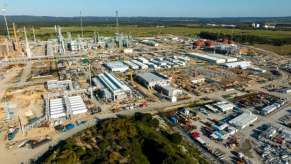
Under the agreements, USAR is advancing a full mine-to-magnet strategy designed to create what it expects could become the largest integrated rare earth production platform in the United States by 2030.
The plan includes commercial production at the Round Top heavy rare earth and critical mineral deposit in Texas by 2028, along with processing of key materials including dysprosium, terbium, yttrium, gadolinium, hafnium, erbium, thulium, lutetium, ytterbium, holmium, gallium, and zirconium—securing domestic access to 12 strategic minerals.
The company also plans to reshore 10,000 tons per annum of heavy rare earth metal and alloy production through its subsidiary Less Common Metals, a capability not currently available in the United States. In parallel, it will scale neodymium-iron-boron (NdFeB) magnet manufacturing capacity in Oklahoma and South Carolina to 10,000 tons per year.
The CHIPS-backed structure ties funding to execution milestones and reimburses capital expenditures as the project advances, aligning federal support with construction progress.
Combined with the January 2026 $1.5 billion private capital raise and earlier funding rounds, USA Rare Earth says total committed capital supporting its growth plan now stands at approximately $3.5 billion.