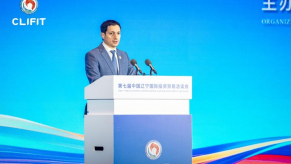
The strategy encompasses over 350 new projects designed to pivot the nation away from raw material exports
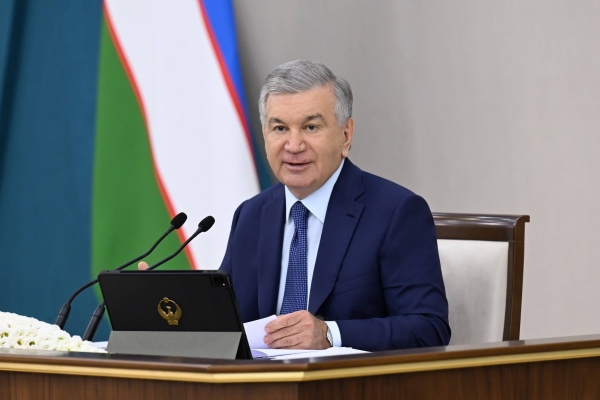
Photo Credit:president.uz
Uzbekistan's President Shavkat Mirziyoyev unveiled a $17 billion transformation roadmap for the country's chemical sector. The strategy encompasses over 350 new projects designed to pivot the nation away from raw material exports by shifting to high-value, consumer-ready goods.
This was announced by the President while chairing a meeting on the tasks for the accelerated development of the chemical industry and the implementation of investment projects in the regions.
It was noted that the country's economy continues to develop dynamically, with industrial sectors launching the production of 3,000 new products in recent years.
"Just 9-10 years ago, the country’s chemical industry was largely limited to the production of mineral fertilizers. Since then, the sector has attracted $8.3 billion in investment, and 87 major production facilities have been commissioned," the release reads adding that more than 60 new high-value-added products have been introduced, including PVC, green hydrogen, expanded polypropylene, and BOPP film.
This has created a solid raw-material base for the production of thousands of new products across various sectors of the economy. As a result, the industry's exports have tripled, while employment has exceeded 50,000 people.
Despite a surge in nationwide industrial output, the chemical sector remains underdeveloped and lags behind. Over the last nine years, while overall industrial growth averaged 6.3% annually, the chemical industry grew by less than 3%.
The sector also suffers from highly inefficient resource allocation. For example, the country currently produces 1.5 million tons of ammonium nitrate annually, which consumes 1.07 billion cubic meters of natural gas. Meanwhile, developed countries are reducing the use of ammonium nitrate, shifting to urea and water-soluble fertilizers in agriculture and to porous prill ammonium nitrate in the mining industry.
President Shavkat Mirziyoyev has ordered a significant expansion of high-value chemical production, highlighting that porous prill ammonium nitrate doubles value-added profits without increasing manufacturing costs compared to conventional alternatives.
In a directive to sector leaders and chemical enterprise heads, the President emphasized maximizing raw materials, noting that $3,700-per-ton cyanide salts from Navoiazot can be converted into adhesive products worth up to $8,000 per ton.
To capitalize on these high-margin opportunities, Mirziyoyev greenlit the launch of 10 low-tonnage chemical initiatives, totaling $1 billion in investment, within the Navoiazot cluster zone.
The country imports household chemical products worth $300 million annually, while the regional market for these products is estimated at $2 billion.
The meeting also reviewed opportunities in the mineral fertilizer market.
Global demand for mineral fertilizers is growing by 5 percent annually and is expected to exceed $260 billion by 2030. Against the backdrop of the adoption of new agricultural technologies, demand for water-soluble fertilizers is growing particularly rapidly.
Responsible officials and khokims were tasked with implementing 42 projects worth a total of $2.8 billion over the next three years. Through these projects, annual production of nitrogen fertilizers is expected to increase from 2.8 million tons to 4 million tons, phosphate fertilizers from 400,000 tons to 900,000 tons, and water-soluble fertilizers from 100,000 tons to 400,000 tons by 2030.
It was noted that the implementation of large-scale projects in the production of water-soluble fertilizers, polymers, household chemicals, and inorganic chemicals will increase demand for specialists in such advanced fields as nanochemistry, green chemistry, supramolecular chemistry, and AI-based chemical modeling.
In this regard, a decision was made to create a comprehensive system in the chemical industry covering education, scientific research, laboratories, and startups.
For this purpose, an innovative scientific, industrial, and educational cluster for the chemical industry will be established on a 60-hectare site in Mirzo Ulugbek district. A Chemical Technology Innovation Center will be created within the cluster in cooperation with South Korea. The center will reimburse up to 50 percent of costs associated with pilot and experimental projects.
Responsible officials were instructed to develop and begin implementing a program for launching more than 350 chemical industry projects worth $17 billion.
The President emphasized that achieving these ambitious goals requires managing the industry based on modern, science-based approaches. In this regard, responsible officials were instructed to carry out the transformation of JSC Uzkimyosanoat.
Subscribe to our newsletter & stay updated.