As electric vehicles push battery management systems to voltages of up to 800 V, protecting the increasingly complex electronics inside them is becoming critical.
Selective PCB potting is emerging as an important way to shield automotive electronics from mechanical stress, temperature fluctuations, moisture and other conditions that can threaten long-term reliability.
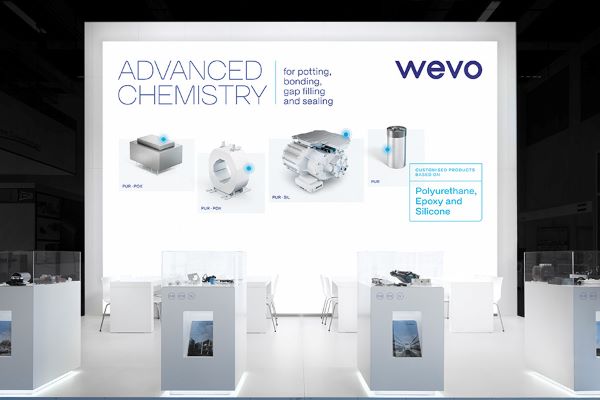
WEVO-CHEMIE GmbH has developed WEVOPUR 60210 FL T, a polyurethane potting system specifically designed for multilayer printed circuit boards (PCBs) in battery management systems (BMS).
The material combines electrical insulation, thermal conductivity and tailored mechanical properties, while its rheology is designed for automated processing using the dam-and-fill method.
Modern BMS electronics integrate not only voltage monitoring and control functions but also diagnostic, communication and safety features. That increasing integration puts greater demands on the PCBs, which must withstand vibration, mechanical loads, changing environmental conditions and high operating temperatures.
WEVOPUR 60210 FL T has a Shore hardness of D 40 to 50, allowing the polyurethane to absorb shocks, vibrations and stresses generated by temperature changes. Its thermal conductivity of 0.8 W/m·K helps distribute heat through the potted assembly and reduce temperature differences between components.
According to Wevo, this can lower the risk of stress cracks and solder-joint detachment. Optimised adhesion also creates a durable bond between the potting compound and substrate, helping to prevent delamination while securely fixing and stabilising electronic components.
Electrical insulation is another key requirement in high-voltage BMS applications. The material offers a dielectric strength of more than 20 kV/mm. Its formulation is also designed to help prevent electrochemical corrosion and protect components against moisture.
The material has been engineered for selective potting using the dam-and-fill process. Its flow behaviour and thixotropy allow it to form a stable barrier while the filler flows into and wets the area being protected without creating air pockets.
This makes the system suitable for automated processing with standard two-component (2K) mixing and dosing equipment. The approach can also reduce the demands associated with material qualification, storage and process management.
Selective potting provides manufacturers with additional flexibility: sensitive electronic areas can be protected while connectors and test points remain accessible. Material volume and layer thickness can also be adjusted to accommodate different PCB geometries by changing the application process and speed.
As BMS designs become more compact and sophisticated, manufacturers increasingly need materials that balance mechanical, electrical, thermal and processing requirements.
Wevo says its decades of polyurethane expertise enable it to develop systems tailored to specific potting processes and applications. Its portfolio includes materials designed for demanding requirements such as high-temperature resistance, chemical resistance and electrical conductivity.
For EV battery management electronics, the objective is clear: protect increasingly complex PCBs without compromising automated production — helping manufacturers build systems capable of withstanding the demanding conditions of modern electric vehicles.