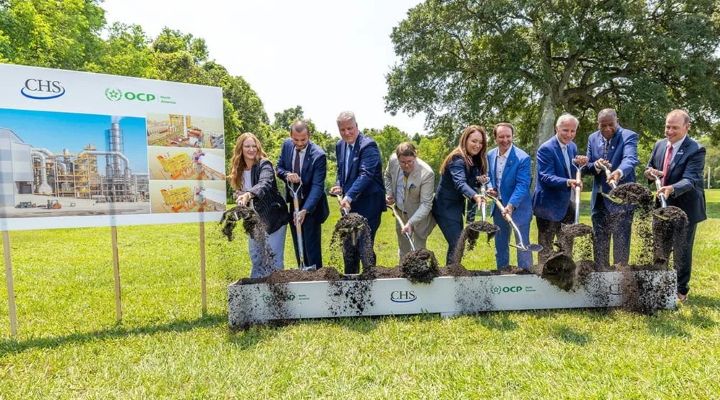
CHS and OCP North America are proposing a major new phosphate fertilizer plant in Louisiana, a project that could inject up to $450 million into U.S. fertilizer production and significantly reduce the country’s dependence on imports.
The farmer-owned cooperative and OCP Group subsidiary plan to build and operate the facility at the Cornerstone Energy Park in Waggaman, Louisiana. If approved, the plant would produce more than 1 million metric tonnes of phosphate-based fertilizer a year — making it the first new phosphate fertilizer facility of its kind built in the United States since 1984.
The project comes as U.S. phosphate reserves decline and the country increasingly relies on foreign supplies. About 40% of the phosphate-based fertilizer used to meet U.S. farmer demand is currently imported, according to CHS.
The companies estimate the new capacity could reduce U.S. dependence on imported phosphate fertilizer by more than 48%, strengthening domestic supply for farmers.
“This is an exciting moment for American agriculture,” said Jay Debertin, president and CEO of CHS. “As a farmer-owned cooperative, we exist to help farmers succeed. Together with OCP North America, we have the opportunity to build the first phosphate fertilizer plant in the U.S. in more than 40 years. This investment has the potential to create more value for our owners by bringing fertilizer production closer to the American farmer and the cooperative network.”
Under the proposed joint venture, OCP Group would supply phosphoric acid to the Louisiana facility, leveraging its global phosphate resources and expertise.
Finished fertilizer would be distributed by both OCP North America and CHS through their extensive U.S. crop-nutrient networks.
The Waggaman location is strategically positioned within the Cornerstone Energy Park, providing access to raw materials and transportation through the Mississippi River system.
"This project represents a milestone in OCP North America’s commitment to serving American agriculture,” said Kevin Kimm, CEO of OCP North America. “Together with CHS, we aim to build lasting infrastructure that strengthens U.S. food security and delivers a reliable, domestically produced supply of the crop nutrients American farmers need.”
The project is also expected to deliver a significant economic boost to Jefferson Parish.
Once approved, the facility is projected to create about 60 permanent jobs and 500 construction jobs. The companies estimate the project could generate a total impact of 924 direct and services-support jobs.
Construction is expected to take up to 24 months, subject to project and funding approvals.
“This announcement by CHS and OCP North America further solidifies the Cornerstone Energy Park and Jefferson Parish as key economic development locations attracting global industry,” said Matthew Sokol, president and CEO of Cornerstone Chemical Company.
"As one of the largest employers in Jefferson Parish supporting hundreds of employees who call South Louisiana home, the Energy Park plays an important role in the area economy and the Greater New Orleans region.”
The proposed plant also dovetails with the U.S. government’s push to expand domestic fertilizer manufacturing and strengthen agricultural supply chains.
CHS and OCP have submitted an application for potential funding through the U.S. Department of Agriculture’s Fertilizer Investment & Expansion for Long-term Domestic Supply, or FIELDS, program.
The companies have also pledged charitable contributions to communities in the greater New Orleans area.
“OCP believes that where we do business, we have a responsibility to invest in the people and communities around us, and we're proud to stand with CHS in making that commitment to greater New Orleans,” stated Kevin Kimm, CEO of OCP North America.
“At CHS, we operate with the value of cooperative spirit, which means we invest in the communities where we live and work,” said Debertin. “We are excited to be joining with OCP to invest in this area as it supports a key role in serving America’s farmers.”
The project remains subject to project-related and funding approvals. CHS also cautioned that its projections about the facility and its future impact are forward-looking statements and could change depending on regulatory approvals, engineering, commodity prices, government policies, tariffs, market conditions and other factors.