The future of industrial competitiveness is being rewritten by the urgent need for sustainable and chemistry

The chemical industry is no longer just managing cycles; it is surviving a sustained storm of geopolitical volatility, supply chain fragmentation, and high energy costs. These aren't temporary headwinds—they are the new, harsher reality. For R&D leaders, the era of relying solely on cost optimization is no longer sufficient. To thrive, innovation must move from the laboratory bench to the center of the boardroom table, transforming R&D into the strategic engine for resilience.
We must stop asking how to make the same product cheaper and start asking how to make our supply chain unbreakable. This requires aggressively developing alternative feedstocks to break dependency on single-source, high-risk raw materials. Localized and diversified sourcing is no longer just a supply chain function; it requires R&D to validate new materials and qualify new suppliers rapidly.
Raw material diversification—embracing bio-based, recycled, and alternate feedstocks—is no longer a "nice-to-have" sustainability goal; it is a critical imperative for long-term survival. Modern competitiveness hinges on cost resilience, supply security, and regulatory readiness. Embracing these alternatives allows businesses to secure supply chains, meet green customer demand, and command premium pricing, making it a powerful tool for strategic differentiation.
Abandoning "Cheaper at Scale" for Smarter, Continuous Speed
In today’s volatile market, ‘Bigger is better’ alone is increasingly insufficient in volatile markets. Traditional large-scale batch processing is now too slow and rigid, creating excessive inventory risks. To stay competitive, we are shifting from "cheaper at scale" to "smarter at speed" by embracing process intensification and continuous manufacturing.
This is not mere incremental change; it is a fundamental redesign of our production DNA. By pivoting to continuous flow, we are replacing inefficient, large-scale vessels with compact, high-throughput technologies—such as flow reactors, cavitation reactors, and static mixers—to drive superior efficiency.
The era of "building, testing, and failing" in industrial process development is ending. We are in the midst of a manufacturing shift where digital simulations and artificial intelligence are no longer luxuries but essentials for competitive manufacturing. Digital twins, digital simulations, and AI are transforming manufacturing from reactive, trial-and-error workflows into proactive, high-efficiency operations. By layering physics-based modelling with AI-driven insights, we are seeing meaningful improvements in productivity, energy efficiency, and faster scale-up, proving that the future of industrial chemistry is digital.
Quality over Ratio
The biggest mistake companies make in scaling up chemical processes is treating engineering as an afterthought. Too often, teams master the chemistry in a lab beaker, only to have the project fail when confronted with the realities of industrial production. Our strategy flips this approach: success is not merely moving from grams to tons; it is building a robust, intensified process at the bench stage by focusing on heat transfer, mass transfer, and mixing limitations before designing a pilot plant.
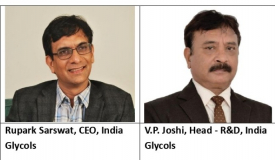
I strongly believe that the scale-up ratio is less important than the quality of data generated during validation. A smaller, well-understood step can be safer than a massive leap in volume. For instance, our development of Lyocell filament yarn represents the future—a greener, closed-loop, and intensified process with one-third the footprint of conventional viscose methods. Similarly, our Recyclamine backward integration program proves that a systematic, data-driven approach from lab to pilot to commercialization is the only way to avoid the "Valley of Death" in scale-up.
Green and Circular Chemistries
The future of industrial competitiveness is no longer just about optimizing speed or reducing traditional input costs. It is being rewritten by the urgent need for sustainable, circular chemistry. Embracing green chemistry is not merely a regulatory checkbox but a strategic imperative that directly drives market access, consumer trust, and long-term brand differentiation.
While the transition to circular processes—utilizing recycled, bio-based, or waste-derived feedstocks—can initially incur higher costs compared to conventional, fossil-based methods, this should not be viewed as a hindrance. Instead, it highlights that sustainability must be embedded at the core of business strategy rather than treated as an isolated, optional initiative.
Circular chemistry creates immense value by enabling premium pricing in conscious, regulated markets and strengthening sustainability narratives that customers now demand. The true commercial upside comes through securing market access, differentiating brands, and developing advanced, sustainable materials.
Our own portfolio demonstrates this transition is achievable and profitable, featuring innovations such as Lyocell filament yarn, Recyclamine for recyclable composites, solvent-free liquid epoxy resin, and high-performance recycled fiber products. By rethinking the entire product lifecycle, we are not just complying with the future—we are building it.
Barriers to Make Industry Standard
Recyclamine technology renders thermoset composites recyclable, overcoming the traditional "unrecyclable" status of epoxy composites used in infrastructure like wind blades. Despite this breakthrough, widespread adoption faces significant hurdles, including the need for regulatory enforcement of end-of-life mandates, the development of a complete circular ecosystem, and strong sustainability branding.
Next-Gen Specialty Molecules
The epoxy industry is navigating the China-plus-one shift by accelerating the development of bio-based epoxies, halogen-free flame retardants, and the world's first solvent-free liquid epoxy process to ensure supply chain resilience. To mitigate risks, future-focused strategies prioritize backward integration, creating in-house sourcing for raw materials and hardeners.
The relentless push for smaller, faster, and more powerful electronics—from wearables to autonomous vehicles—has created a paradox: how do we pack more heat-generating capability into smaller spaces?
At our R&D center, we believe the answer lies not in traditional heat sinks, but in advanced, proactive encapsulation and potting materials. Our current epoxy systems are widely used and trusted in the automotive, power transition, and mobility sectors, providing trusted electrical insulation. However, "good enough" is no longer enough. The next frontier is micro-scale high-power electronics. We are talking about integrated circuits (ICs), microcontrollers, and transistors that operate at temperatures and power densities that would have fried components a few years ago.
Future of Coatings
The era of relying on controversial substances in industrial coatings is ending, driven by both strict regulation and a moral imperative for safer alternatives. Having successfully developed a patented BPA-free epoxy platform for food and can coatings, our next logical step is extending this chemistry into water pipe systems to remove hazardous material leaching.
The real innovation challenge, however, is that removing legacy materials cannot mean sacrificing the performance users demand. Our R&D roadmap is focused on a dual commitment: transitioning away from toxic materials while ensuring unmatched durability, barrier resistance, and regulatory compliance.
Our roadmap addresses the urgent need to phase out not just BPA, but other contentious components like PFAS, shifting toward safer, advanced, and often bio-based materials. We are identifying applications where this new chemistry can replace old standards without compromise, treating safety as a non-negotiable component of high performance.
The industry is moving toward a future where coatings are "safe and sustainable by design," and our goal is to lead that transformation by proving that cleaner chemistry actually enhances long-term reliability.
Ensuring Competitiveness
To stay ahead of the surging tide of Chinese yarn imports, we cannot simply compete on price; we must compete on innovation and sustainability. While our specialized spool-spun technology has long been a differentiator in fine linear segments, the rapid advancement of Chinese manufacturing means we must build the next layer of superiority.
Our strategic pivot is rooted in developing proprietary, greener technology, specifically lyocell filament yarn. Having proven this technology at the lab scale, we are moving beyond conventional, resource-intensive methods. Lyocell offers a superior, closed-loop process that satisfies the growing global demand for sustainable textiles. More importantly, it delivers a high-strength, premium, silk-like yarn that opens doors in both high-end fashion and technical textile markets.
By developing this technology in-house, we are helping build an indigenous competitive advantage. We are moving toward a pilot-scale demonstration over the near term, subject to readiness and validation within the next six months, ensuring we stay ahead of competitors and define the future of sustainable, high-performance yarn.
Ingredient Markets Must Innovate
Even in supposedly mature segments like phosphates, complacency is the enemy of growth. To remain relevant, we must relentlessly focus on green, clean-label solutions driven by customer and R&D engagement. The industry is currently facing a massive shift, driven by growing awareness that excessive sodium intake contributes to hypertension and cardiovascular risks.
Our answer is to aggressively pivot toward low-sodium formulations, replacing traditional sodium-based ingredients with functional, calcium-based alternatives, particularly in bakery and dairy applications. To support this, we have developed in-house mono, di, and tri-calcium phosphate technologies that not only improve nutrient absorption but also enhance texture and shelf life, creating a "better-for-you" product that consumers actually want to eat.
Innovation doesn't stop there. We are pioneering calcium, magnesium, iron, and sodium aluminium phosphate systems to target high-value markets like fortified foods and beverages. Furthermore, in sulfites, we are moving beyond conventional sodium options by promoting potassium metabisulfite to serve as a cleaner preservative in wine processing and starch applications.
This in-house development is just the beginning. Our small-scale initiatives are rapidly moving toward expansion, proving that even in a 100-year-old industry, there is plenty of room for forward-thinking science.
Designing Advanced Wastewater Treatment System
For years, our Aqua Armor portfolio has reliably served aquaculture, municipal, and drinking water applications. In these sectors, targeted chemistry works wonders. But the landscape shifts dramatically when we step into industrial wastewater.
Industrial wastewater is a complex, often chaotic mix of high COD (Chemical Oxygen Demand), BOD (Biological Oxygen Demand), TDS (Total Dissolved Solids), metallic impurities, and wildly heterogeneous contaminants. Relying on a single, standalone chemical product to handle this complexity is not just naive—it is ineffective.
That is why we are shifting our focus from merely supplying chemicals to designing holistic, advanced treatment systems.
Textile Recycling Technologies
For too long, the industry has relied on "low-hanging fruit"—pure cotton or simple polyester recycling. Our fiber business has already pushed this boundary with Liva Reviva, pioneering a process that integrates around 20% to 30% recycled cotton remnants into viscose manufacturing, blended with responsibly sourced wood pulp. It is a successful step, but it is just the prologue. The real challenge, and where our focus has shifted, is post-consumer textile waste.
Future Outlook for the Indian chemical industry
The biggest opportunity for India lies in significantly increasing R&D and innovation investment. As an industry, our R&D spending is still far below what is needed. If India wants to truly capture the China-plus-one opportunity, we must build indigenous technologies instead of depending on imported process know-how.
Imported technology is never plug-and-play. It must adapt to our raw materials, people, process conditions, and market realities. That is why the long-term path forward is clear: India must invest in its own chemical science, process engineering, and technology platforms.
Subscribe to our newsletter & stay updated.