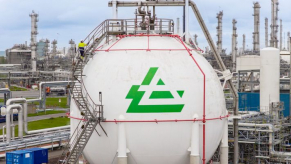
Selenis is significantly expanding its specialty copolyester manufacturing footprint with the acquisition of production assets from Polisan Hellas in Greece, pushing the company’s installed annual capacity beyond 200,000 metric tonnes by 2028. The capacity expansion is 100% funded by the IMG Group.
The assets will be relocated to Portugal, adding continuous polymerisation to Selenis’ existing manufacturing platform across Portugal, Italy, Tunisia and the United States.
The move strengthens Selenis’ ability to combine high-volume continuous production with the flexibility of batch manufacturing, allowing the company to serve everything from standardised grades for major packaging markets to highly specialised and customised materials.
“We believe Europe needs a strong specialty materials manufacturing base, and we are investing to build it,” said Duarte Matos Gil, CEO of Selenis. “When customers qualify our materials, they make a long-term commitment. Our responsibility is to invest ahead of their needs, to put more than one plant behind every grade and to give them a cost base that lets them compete. This acquisition puts industrial capacity behind that commitment, and further steps will follow.”
The acquisition gives Selenis continuous polymerisation capability alongside its established batch production operations.
Continuous production is designed for high-volume grades where consistency, standardisation and cost per tonne are critical. Batch manufacturing, meanwhile, remains geared towards specialty and custom grades requiring smaller production runs, rapid changeovers and greater formulation flexibility.
The combined platform is intended to give customers access to both manufacturing models while strengthening supply security across multiple regions.
Selenis plans to qualify selected grades at more than one manufacturing site, enabling customers to source the same specification from multiple plants and shift volumes between locations as demand and logistics change.
European customers will be supplied from European production, while customers in the United States will be supplied from U.S. manufacturing operations. The company says the regional model will support shorter lead times and reduce the safety stocks typically associated with imported resin.
“Our ambition is to be the supplier customers choose for their next generation of products,” added Duarte Matos Gil. “That takes technical depth, dependable supply from more than one plant and the capacity to grow with them. We are building Selenis for that responsibility.”
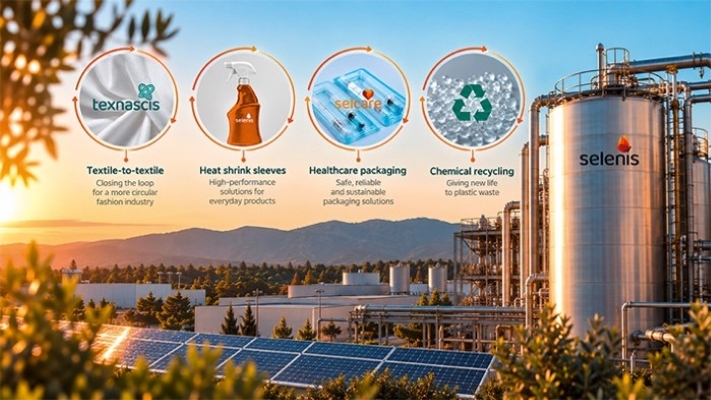
The new continuous production capability will initially target standard grades used in high-volume applications including shrink sleeves, film and sheet.
Selenis is also targeting growth in healthcare, 3D printing and textile-to-textile recycling.
In healthcare, Selcare is positioned around the multi-site qualification and supply continuity required by demanding medical applications.
In 3D printing, Mimesis supplies PETG and PCTG resins to filament manufacturers serving industrial, automotive, electronics, education and consumer applications, ranging from functional prototypes to end-use parts.
In textile-to-textile recycling, Texnascis works with chemical recycling partners to convert recovered monomers into new polyester. Selenis says its polymerisation expertise and expanded industrial scale will help move these technologies towards commercial volumes.
The continuous production model also gives Selenis a lower conversion cost per tonne than batch production for suitable high-volume grades. The company intends to use that cost advantage to support long-term supply agreements with customers able to commit predictable volumes.
The Polisan Hellas assets will be installed in Portugal as part of Selenis’ previously announced capacity expansion.
The company says its industrial footprint is already being assessed for further investment, with potential projects in Germany and Tunisia.
“We are evaluating new investments in Germany in the bio-based field and in Tunisia, where we are exploring textile-to-textile opportunities through DMT technology. Each investment adds a capability to one manufacturing platform, and each is chosen for the markets where our customers see the strongest long-term growth,” said Eduardo Santos, Strategy & Integration Director at IMG Group.
Selenis says the broader expansion is aimed at giving customers greater supply security, manufacturing scale and operational flexibility as demand grows for specialty copolyesters across technical applications.