Targeting start-up in the second half of 2026; in-house feedstock to enhance cost competitiveness in the recycling business
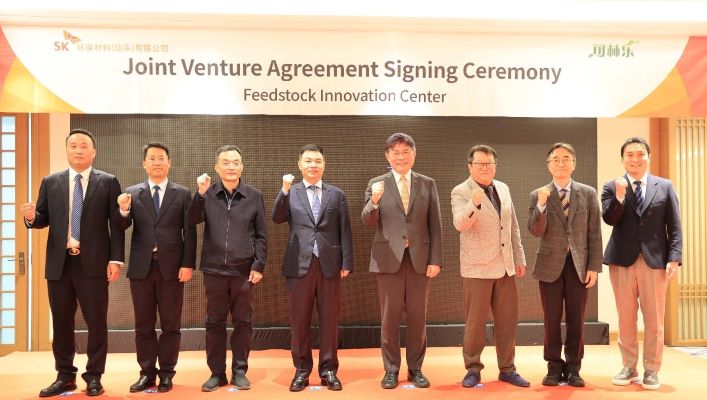
SK Chemicals President Ahn Jae-hyun (fifth from left), SK Shantou Vice President Jung Jae-jun (sixth from left), Kelinle President Zhang Xizheng (far left), and other representatives pose for a commemorative photo after the signing ceremony.
SK Chemicals has signed a joint venture agreement with Kelinle, a leading plastics recycling company in Shaanxi Province, China, to build the (FIC), a facility for processing waste plastics.
The Feedstock Innovation Center (FIC) will process waste plastics into feedstock. Once the facility is completed, SK Chemicals will secure a value chain that extends beyond the production of chemically recycled materials to encompass the sourcing of waste plastics. Among domestic chemical companies pursuing depolymerization-based chemical recycling, SK Chemicals is the first in Korea to establish a corporate entity equipped with facilities for sourcing waste plastics.
The two companies plan to establish a process on an idle site of about 13,200 m² owned by Kelinle in Weinan, Shaanxi Province, China, to convert waste through a series of steps into recycled raw materials. Kelinle, which has operated a plastics recycling business in the local market for the past 10 years, will leverage its local network to procure feedstock, and PET pellets will be produced after pretreatment using SK Chemicals' technology.
The Feedstock Innovation Center (FIC), unlike mechanical recyclers that rely on PET bottles as feedstock, will be designed to convert end-of-life textiles, such as discarded blankets and the fines generated during PET-bottle shredding, into feedstock for chemical recycling. It will start with an initial capacity of approximately 16,000 tons per year of PET pellets and will ramp up to about 32,000 tons per year, supplying most of the feedstock required by SK Shantou.
Ahn Jae-hyun, CEO of SK Chemicals, said, "With the FIC, we have secured a complete recycling value chain that extends from depolymerization and material production to feedstock sourcing. The cost advantage gained by turning hard-to-recycle wastes such as discarded blankets into resources will help break down the price barrier of recycled plastics, which has historically been higher than petroleum-based materials."
Meanwhile, SK Chemicals established a chemical recycling-based production subsidiary in Shantou, China, in 2023, creating a global hub for circular recycling with the commercial production of r-BHET and CR-PET.
In Korea, the company has built the Recycle Innovation Center (RIC) at its Ulsan plant, linking depolymerization pilot facilities with copolyester production to form a research-to-production bridge. At the same time, SK Chemicals has been advancing its circular recycling value chain by accumulating depolymerization and repolymerization technologies for textile waste, including discarded banners and fabrics.
Subscribe to our newsletter & stay updated.