A team of researchers at Hanbat National University has developed a novel battery separator that could address two of the biggest challenges facing next-generation lithium-metal batteries: maintaining high performance at rapid charging and discharge rates while preventing dangerous dendrite growth.
Led by Professor Sun-Yul Ryou of the Department of Chemical and Biological Engineering, the researchers created a cellulose-based separator infused with bikitaite zeolite, known as CBT. Their findings show that the material not only stabilizes the lithium-metal anode but also dramatically improves the high-rate performance of high-nickel NCM90 cathodes.
Lithium-metal batteries paired with high-nickel cathodes such as NCM90 are attractive because of their potential for exceptionally high energy density. Yet their performance can deteriorate rapidly under demanding operating conditions. Fast cycling can trigger lithium dendrite formation, electrolyte degradation and, ultimately, short circuits.
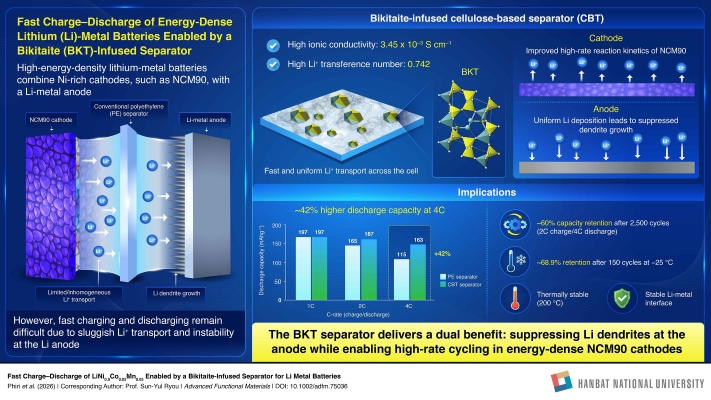
The new CBT separator tackles these problems by creating interconnected pathways that enable lithium ions to move rapidly and more uniformly throughout the cell. The result is improved electrochemical performance at high rates, alongside more uniform lithium deposition at the anode.
The separator combines cellulose's naturally porous structure with the ion-transport properties of bikitaite zeolite. Researchers measured an ionic conductivity of 3.45 × 10⁻³ S cm⁻¹ and a lithium-ion transference number of 0.742, properties that promote faster ion movement while reducing polarization under demanding conditions.
"Our results show that battery performance can be improved not only through new cathode and anode materials, but also through separator engineering. What was particularly interesting was that the effect of the modified separator extended beyond the lithium-metal anode and significantly improved the high-rate performance of the NCM90 cathode," explains Prof. Ryou.
The performance advantage became increasingly pronounced as the discharge rate increased.
At 1C, cells using the CBT separator and conventional polyethylene separators delivered approximately the same capacity—197 mAh g⁻¹. But at 2C, the CBT-equipped cell delivered 187 mAh g⁻¹, compared with 165 mAh g⁻¹ for the conventional separator.
At 4C, the gap became striking. The NCM90 cathode delivered 163 mAh g⁻¹ with the CBT separator, compared with just 115 mAh g⁻¹ using the conventional separator—an improvement of approximately 42%.
The separator also demonstrated a critical advantage on the lithium-metal side.
Real-time observations of lithium deposition revealed no visible dendrite growth in cells equipped with CBT. Instead, lithium formed a smoother and more compact layer and was removed more uniformly during stripping. This suggests that the separator can simultaneously support rapid ion transport and improve the stability of the lithium-metal anode.
Long-term testing further highlighted the separator's durability. High-rate Li||NCM90 cells retained roughly 60% of their capacity after 2,500 cycles at 2C/4C. The cells also retained approximately 68.9% of their capacity after 150 cycles at −25 °C and demonstrated stability at temperatures as high as 200 °C.
Perhaps most importantly, the approach could offer a practical alternative to costly electrode redesigns. Because separator modifications can potentially be integrated into existing battery manufacturing processes, the technology could improve cell performance without fundamentally changing the underlying chemistry.
However, further testing in commercial battery formats, including pouch and cylindrical cells, will be needed to determine how effectively the technology translates from laboratory-scale cells to real-world applications.
The researchers believe the findings could signal a broader shift in how battery separators are designed and understood.
"Functional separators should not be viewed only as barriers that separate the two electrodes or as a means of protecting the lithium-metal anode. By controlling ion transport across the cell, they could become an important design element for simultaneously achieving high energy density and high-rate operation in next-generation batteries," concludes Prof. Ryou.
The research points to a potentially powerful new strategy for advancing lithium-metal batteries: rather than focusing solely on improving the electrodes, engineers may be able to unlock substantial gains by redesigning the component that lies between them.