SK Innovation and Bill Gates-backed TerraPower are stepping up cooperation on next-generation nuclear power, targeting the fast-growing electricity needs of AI data centers while laying the groundwork for a Korea-tailored small modular reactor business.
The companies have signed a key terms agreement to jointly pursue the global expansion and potential domestic deployment of TerraPower’s Natrium, a sodium-cooled fast reactor and Generation IV small modular reactor (SMR).
The agreement marks a significant expansion of SK Innovation’s role. The Korean energy company is moving beyond its position as a strategic investor in TerraPower to take a more direct role in SMR development, project execution and global business expansion.
SK Innovation CEO Choo Hyeong-wook and TerraPower CEO Chris Levesque signed the agreement in Seoul on August 14. SK Innovation and SK Inc. jointly invested $250 million in TerraPower in 2022, making them the U.S. nuclear company’s second-largest shareholder.
Under the agreement, SK Innovation will expand its participation in TerraPower’s Natrium demonstration reactor in Wyoming and subsequent commercial projects. The companies will also explore deploying Korea’s nuclear supply chain, developing a domestic sodium SMR business and identifying projects in overseas markets.
A central goal is the development of “K-Natrium,” a Korean-tailored business model for sodium-cooled SMRs.
The companies plan to assess regulatory requirements, industrial capabilities and power-grid conditions in Korea and international markets before refining the model. Korean research and design institutions and nuclear and power-equipment manufacturers are also expected to play a larger role.
The strategy could give South Korea a bigger role in the emerging SMR supply chain while giving SK Innovation practical experience in designing, building and operating advanced reactors.
The push comes as AI data centers drive a sharp increase in demand for reliable electricity.
Natrium is designed to combine a sodium-cooled fast reactor with a molten-salt thermal energy storage system. The storage system can hold heat generated by the reactor and release it when electricity demand peaks, allowing the plant to provide steady power while also responding to fluctuations in demand.
That combination makes the technology particularly relevant to electricity-intensive customers such as AI data centers, semiconductor manufacturing facilities and industrial complexes.
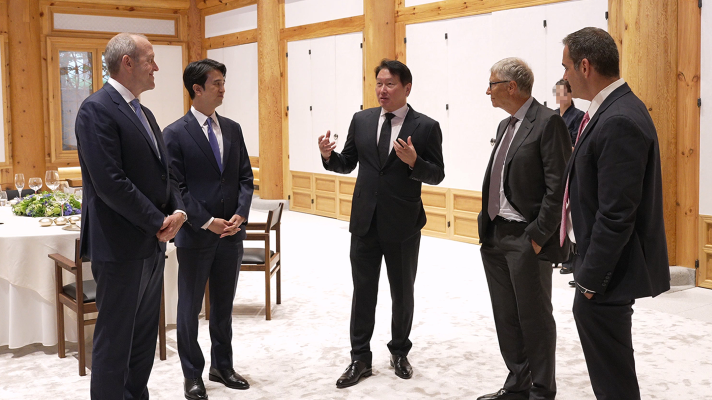
The agreement signing was followed by a dinner attended by SK Group Chairman Chey Tae-won and TerraPower Board Chairman Bill Gates. Discussions focused on rising electricity demand from AI data centers, the future of next-generation nuclear power and opportunities for closer Korea-U.S. cooperation in the nuclear sector.
SK Innovation plans to deepen its involvement in TerraPower’s Kemmerer Unit 1 project in Wyoming, giving the company direct exposure to the development and operation of an advanced nuclear reactor.
The project received a construction permit from the U.S. Nuclear Regulatory Commission in March, according to SK Innovation, marking a major step forward for the commercial advanced-reactor project.
SK Innovation intends to use experience gained from the U.S. project to assess opportunities in Korea and develop SMR projects in overseas markets, including Vietnam, Indonesia and Malaysia.
The companies will also jointly seek additional U.S. SMR opportunities that could qualify for support from the Korean and U.S. governments. Potential cooperation includes project feasibility studies, financing structures, supply-chain planning, construction and operating strategies, and engagement with U.S. government agencies.
The TerraPower partnership also fits into SK Innovation’s broader push to build an integrated energy business around the electrification boom.
SK Innovation has LNG import, power generation and electricity businesses, while SK On is expanding its battery and energy storage system operations. Adding SMRs to that portfolio would allow the group to offer multiple sources of power and storage to large electricity consumers.
The near-term strategy is to use LNG power generation and energy storage systems to meet the initial electricity needs of AI data centers and industrial facilities, while positioning SMRs as a long-term source of stable, carbon-free baseload power.
The approach dovetails with Chey Tae-won’s “AI Full Stack” strategy, which links SK Group’s semiconductor, telecommunications, data center and energy capabilities.
The group envisions connecting SK Hynix’s AI semiconductors, SK Telecom’s data centers and AI infrastructure, SK Innovation’s LNG, power and SMR operations, and SK On’s energy storage batteries into a broader AI infrastructure chain.
For SK Innovation, the TerraPower agreement could turn that vision into a tangible nuclear power business.
Choo Hyeong-wook, CEO of SK Innovation, said, “This agreement is significant in that SK Innovation and TerraPower will jointly explore the domestic application potential of natrium SMRs to meet the growing electricity demand of AI data centers, while also collaborating to expand our global business.
"Through close communication with TerraPower, we will refine the direction of the K-Natridium business model, and by participating in projects in the U.S., we will build the business development and operating capabilities needed to expand our presence in the global market.”
The partnership therefore goes well beyond a conventional investment. As demand for reliable, around-the-clock power accelerates alongside AI infrastructure, SK Innovation and TerraPower are positioning advanced nuclear technology as a potential cornerstone of the next phase of the energy build-out.