Policymakers, stakeholders call for faster capacity creation & innovation to reduce import reliance
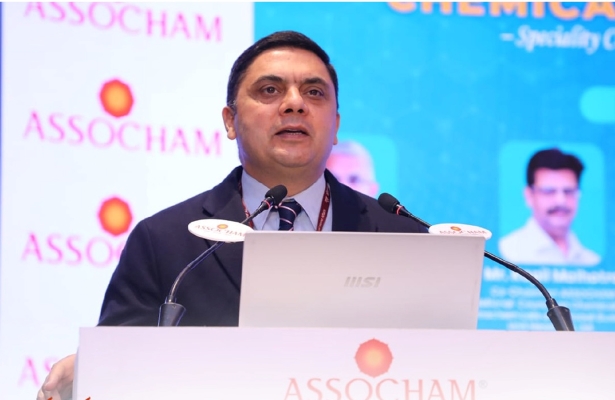
Tejveer Singh, Secretary, Department of Chemicals & Petrochemicals, Ministry of Chemicals & Fertilizers, Government of India
India’s specialty chemicals industry -- among the fastest-growing segments -- is tightening its global foothold as policymakers and industry leaders call for deeper collaboration, capacity expansion, and reduced import dependence.
The momentum came into sharp focus at the recent India Speciality Chemicals Conclave organised by ASSOCHAM, where government officials and industry stakeholders mapped out the sector’s next phase of growth.
Opening the policy signal, Secretary, Department of Chemicals & Petrochemicals, Government of India, Tejveer Singh, warned that global instability is reshaping supply chains and making self-reliance urgent.
Speaking at the event, he said, “The West Asia crisis has caused huge supply chain disruptions and in an age of global uncertainty, it is important for the specialty chemicals sector to be relatively more self-reliant.
"This sector accounts for the second largest big ticket import bill after the petroleum sector and our trade deficit has grown significantly since the turn of the century. The importance of this sector cannot be overemphasised as it sustains the entire industrial edifice of the country.”
He also outlined major policy and infrastructure moves, adding: “In line with the budget announcement, three dedicated chemical parks are being set up with the minimum area of around 8 square kilometres and allocation of 1000 crore each spread over a 5-year period.
"The 18 centres of excellence which have been set up in various technical institutions of the country are doing interesting work and the industry must engage with them for better industry - academia interactions.
"Industry data collection for the Ministry of Statistics and Programme Implementation’s index of industrial production will now be monthly and the data point have been increased from 245 units to about 400 units for the index to be truly representative.”
Industry leaders echoed the urgency to scale up.
Delivering the opening remarks, Sagar Kaushik, Chairman, ASSOCHAM National Council on Chemicals & Petrochemicals said, “A great journey to reposition the chemicals including specialty chemicals sector is underway to achieve the targeted $1 trillion in output by 2040.
"The journey will require unprecedented levels of capacity creation because we have a growing captive demand and we risk a growing import basket if we fail to service the demand. The industry needs a level playing field to unlock our potential to meet growing demands.”
Trade policy concerns also surfaced, with Kapil Malhotra, Co-Chairman, ASSOCHAM National Council on Chemicals & Petrochemicals, cautioning against imbalanced agreements.
"FTAs with smaller third world countries, though they may be advanced can lead to increase in trade deficits because they not have a big Market but for them India is a very big market. They have to come in a form where there is a win-win situation for both the countries who are participating.”
Highlighting resilience amid global headwinds, Nilesh A. Kulkarni, Co-Chairman, ASSOCHAM National Council on Chemicals, said, " In 2025, our domestic trajectory remained very resilient.
"India's chemical market was expanding towards a projected 250 to 300 billion milestone by 2030. The West Asia crisis has shown us that we are in the midst of margin compressions because there is destocking, there is capacity dumping from China and other countries. We need to ensure our feed to downstream speciality chemical sector to build high value products and increase our self-reliance."
The conclave also saw the launch of a joint knowledge report by PricewaterhouseCoopers and ASSOCHAM, reinforcing themes of innovation, export-led growth, and sustainable manufacturing practices.
Across discussions, one message stood out: India’s specialty chemicals sector is no longer just expanding—it is positioning itself as a strategic pillar of industrial growth, resilience, and global competitiveness.
Subscribe to our newsletter & stay updated.