India’s biotech powerhouse ATGC Biotech, based in Genome Valley, Hyderabad, has announced the establishment of Semiophore Ltd, a 50:50 Indo-Israeli joint venture with Luxembourg Industries Ltd, which aims to redefine crop protection globally.
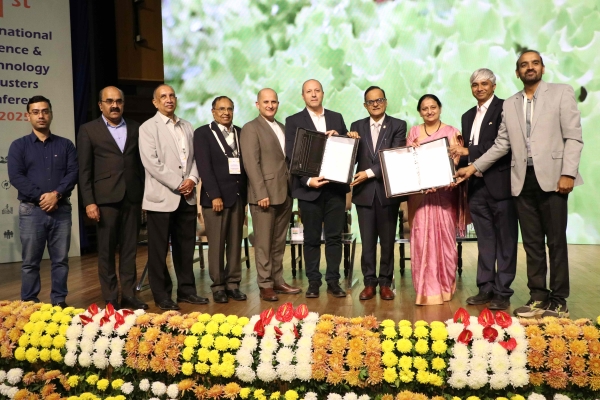
The launch was marked by the exchange of licensing agreements at the First International Science & Technology (S&T) Clusters Conference in New Delhi, attended by global delegates from over 38 countries.
The joint venture represents a US$ 10 million investment from Semiophore, Luxembourg Industries, and ATGC Biotech to establish infrastructure in India and Israel, and to register 18 Indian-developed semiochemical and pheromone technologies for global markets including Israel, Brazil, Australia, and Africa. These technologies, spanning mating disruption, attract-and-kill, aggregation, and anti-aggregation systems, address a multi-billion-dollar global market opportunity.
Under the JV, ATGC Biotech contributes IP, technology, regulatory dossiers, R&D leadership, and capex, while Luxembourg Industries invests in manufacturing, marketing, and regulatory costs.
The partnership brings a new class of crop-protection technologies that use minimal pheromone chemistry with advanced material-science delivery systems, offering season-long, water-free, pollinator-safe, and residue-free solutions that significantly reduce reliance on chemical insecticides while lowering CO₂, water, and plastic footprints.
Speaking on the collaboration, Fares Saeb, Deputy Ambassador of Israel to India, said: “Israel and India share a strong partnership in agriculture and technology. Today’s licensing exchange represents an important step toward expanding sustainable, environmentally safe crop protection. The establishment of Semiophore exemplifies the growing global relevance of Indo–Israeli innovation, and we congratulate both partners on this milestone.”
Uri Rubinstein, Agriculture Attaché, MASHAV, added: "ATGC Biotech has been a consistent and active participant in our training programs, Centers of Excellence, and capacity-building efforts across India. Their work aligns with our shared goal of strengthening farmer livelihoods through sustainable and innovative agricultural practices. The creation of Semiophore Ltd. represents a meaningful extension of Indo–Israel cooperation in advanced agriculture, and we look forward to continued collaboration.”
Dr. Rajesh S. Gokhale, Secretary, Department of Biotechnology (DBT), Government of India, said: “DBT is pleased to note the establishment of Semiophore Ltd., the Indo–Israeli Joint Venture between ATGC Biotech and Luxembourg Industries. This milestone showcases the strength of India’s biotechnology ecosystem and demonstrates how long-term public investment in science can translate into globally deployable technologies."
"It is particularly encouraging that, for the first time, technology developed through Indian science and supported by DBT and BIRAC will now be manufactured and distributed in Israel through the Semiophore joint venture.”
On behalf of ATGC Biotech, Arjula R. Reddy, Rolando Alegria, CEO, VB Reddy, ED, and Markandeya Gorantla, Chairman & MD, said: “This is a defining moment for India’s bioeconomy and for the global semiochemical industry. For the first time, Indian-developed semiochemical technologies will be manufactured and commercialized in Israel, marking a new chapter in Indo–Israeli scientific and industrial cooperation.
"The JV will begin initial commercial batches in 2026 and scale to full capacity in 2027, subject to regulatory approvals. Together with Luxembourg Industries, we are creating a globally competitive platform that positions India and Israel at the forefront of sustainable, residue-free, climate-resilient agriculture.”
Moshik Fish, CEO, Luxembourg Industries & Director, Semiophore, said: “The Semiophore partnership brings together India’s scientific strengths and Israel’s agricultural expertise. We are delighted to deploy India’s next-generation pheromone technologies across Israeli agriculture.”
The Semiophore JV aims at shifting agriculture from chemical-dependent methods to behavior-based, biologically-led, climate-smart solutions for crops including grapes, apples, citrus, almonds, tomatoes, cotton, corn, cabbage, cauliflower, and avocados.