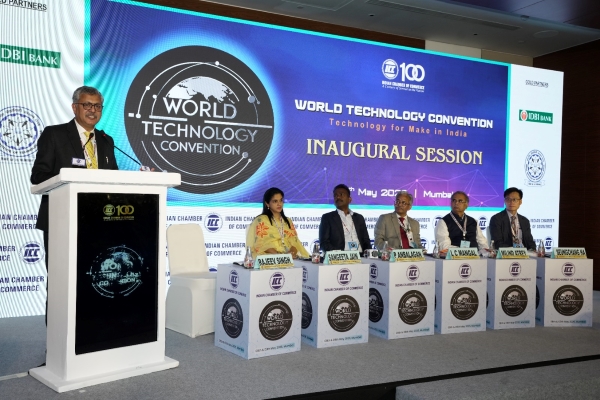
India’s technology ambitions recently took centre stage in Mumbai.
This was with the Indian Chamber of Commerce wrapping up the ICC World Technology Convention 2026 after two days of high-level debate on how emerging technologies will reshape the country’s industrial and economic future.
Held at the Jio World Convention Centre, the convention brought together more than 700 policymakers, industry leaders, researchers, startups, technology companies and global delegates, all focused on one message: India’s next growth phase will depend on how rapidly and deeply it adopts technology across sectors.
Discussions on the final day zeroed in on artificial intelligence, smart mobility, manufacturing competitiveness, water sustainability, GCCs and Industry 4.0, with infrastructure and mobility emerging as major themes.
Abhijeet Sinha, Programme Director, EoDB and NHEV, said India’s infrastructure push is now shaping global trade dynamics far beyond its borders.
“India is not merely building roads within its borders; outside them, it is defining the economic parameters on which a global paradigm shift will take place. The India-Middle East Corridor announced in 2023 is nothing less than the restoration of a trade architecture that once gave India 23 percent of global GDP.
"Domestically, the Prime Minister's 7C vision is now being delivered through the Triple E framework of electric, electronic and efficient highways. When we needed the 30 MHz spectrum for vehicle-to-vehicle communication, cabinet and Ministry of Road Transport approvals came within 30 days, because governance today is evidence-based, not endlessly consultative.
"The answer to road discipline lies in mandating ADAS across all vehicles and linking it to VEDAS, the Vehicle Electronic Data Analytics System, so that every violation is recorded, retrievable and actionable.”
The convention also underscored the growing urgency around technology-led industrial transformation.
“What this convention reflects is not just the breadth of India's technology ambition but the urgency behind it. Across every session, every sector and every conversation over these two days, the message has been consistent: technology is no longer a support function, it is the primary driver of industrial competitiveness, policy making and economic growth.
"ICC is committed to making this convention a globally relevant platform that connects India's innovation ecosystem with the world, brings the right stakeholders into the same room, and ensures that the ideas discussed here translate into partnerships, policies and outcomes that matter,” said Rajeev Singh, Director General, ICC.
The event drew senior voices from government, industry and academia, including Amitabh Ray, Aankur Patni, Aman Kirloskar, Adolfo García Estrada and Rahul Sahai.
Day one of the convention widened the focus to sectors including greentech, Mining 5.0, defence and aerospace, agritech, medtech, fintech, cybersecurity and education technology, alongside dedicated state sessions and B2B meetings.
A major outcome of the event was the signing of bilateral MoUs between ICC and IIT Bombay as well as South Korea’s Chungcheongnam-do Economic Promotion Agency, aimed at deepening industry-academia collaboration and expanding India–South Korea business ties.
Deepak Bagla, Mission Director, Atal Innovation Mission, NITI Aayog, said India’s innovation story is no longer limited to startup numbers alone, but increasingly reflected in how the culture of innovation is spreading to students and communities previously excluded from the ecosystem.
Professor Milind Atrey, Deputy Director, IIT Bombay, called for research, pushed for faster commercialisation of research through stronger industry partnerships.
Across both days, speakers repeatedly stressed that deeper collaboration between industry, academia and government will be critical if India is to emerge as a global manufacturing and digital powerhouse over the coming decade.