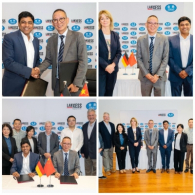
AM Green has already secured a strong export-oriented offtake pipeline including a binding offtake agreement with Uniper, Germany for upto 500 KTPA starting Q2 2028
_IndianOil_400_800.jpg)
How is AM Green's green-ammonia project progressing? What technology and design parameters have been finalized for electrolysers?
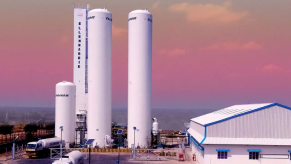
AM Green is currently executing 1 million tonne per annum (MTPA) green ammonia complex at Kakinada, Andhra Pradesh. The site is the erstwhile Nagarjuna Fertilizers facility which was acquired and being repurposed as AM Green Ammonia Pvt. Ltd. The complex is coming up on 495 acres of land with an overall 3,000 tonnes of capacity per day for producing green ammonia. The project has achieved Final Investment Decision (FID) in August 2024 and construction is progressing rapidly and is expected to be completed in 37 months i.e. September-October, 2027.
The plant is based on 1.28 GW advanced pressurised alkaline electrolyser capacity supplied by John Cockerill, Belgium, under a long-term strategic partnership. The electrolysers are configured in 5 MW stacks, with each stack producing approximately 100 Nm³ per hour of hydrogen equivalent to around 90 kg of green hydrogen. In the first phase of 0.5 MTPA, 128 stacks will be deployed, aggregating to about 640 MW electrolyser capacity.
What is the timeline for deployment of two phases of 640 MW electrolyser installation? Dates for commissioning and expected hydrogen and ammonia production ramp-up curve post-start-up in 2027?
From the point of FID, the project follows a 37-month execution timeline, with mechanical completion targeted for September-October 2027. The first 20 MW electrolyser block is expected to be commissioned by Q1 2027. Full Phase 1 capacity of 0.5 million tonnes of green ammonia is scheduled to be achieved by October 2027. Phase 2, which mirrors the scale and configuration of Phase 1 is planned for commissioning around 2028. Once both phases are operational, the cumulative electrolyser capacity will reach approximately 1.28 GW producing around 545 tonnes of green hydrogen per day for downstream ammonia synthesis.
What is the Capex committed for the Kakinada project? What is the expected levelized cost of hydrogen at full scale?
It is a multi-billion dollar investment and all financial commitments are already in place and disbursements have also commenced.
From a cost perspective, recent public tenders in India indicate green hydrogen prices in the range of Rs. 320–330 per kg as per Indian standards and the same may be expected to be 25-30% more for RFNBO standards. AM Green expects to be highly competitive and potentially the cost will be below this range which is driven by large-scale renewable integration, pumped storage, and economies of scale. Globally, green ammonia prices vary depending on carbon intensity and certification. Grey ammonia trades at around US $ 500 per tonne today while highest standard green ammonia compliant with EU RED III or RFNBO standards is priced at upwards of US $800 per tonne. Intermediate grades typically trade between US $600-$800 per tonne. Final pricing will ultimately depend on certification standards, which are currently under revision in India.
The Ministry of New and Renewable Energy (MNRE) and the Office of the Principal Scientific Adviser (PSA) to the Government of India have constituted a committee to revise India’s green ammonia standards and incentive framework where I am serving as convener of the committee. The committee has submitted its report to the government and until these standards are formally notified, cost comparisons need to be interpreted carefully as the term ‘green ammonia’ represent very different levels of carbon intensity.
AM Green’s Kakinada project is designed to produce deep green ammonia with a carbon footprint of approximately 0.05 kg CO? per kg of product (at gate), which significantly exceeds the EU RED III requirement of 0.5 kg CO? per kg (including shipping, storage and cracking,if any). Kakinada project will be India’s first commercial-scale green ammonia and green hydrogen facility. It is already among the first few globally to receive pre-project EU RFNBO certification based entirely on its design, configuration, and power sourcing architecture.
AM Green has set a target to reach 5 million tonnes per annum (MTPA) of green ammonia by 2030 equivalent roughly to about 1 MTPA of green hydrogen. What are the intermediate capacity milestones for hydrogen/ammonia production and which other sites beyond Kakinada are planned for expansion?
AM Green has a clear and structured roadmap to reach 5 million tonnes of green ammonia capacity by 2030, equivalent to roughly one million tonnes of green hydrogen annually. At Kakinada, the capacity can be expanded to 2 million tonnes with land and resources already secured. Land parcels have also been secured at Tuticorin and Kandla Port for an additional two million tonnes. One more site is currently under evaluation for the remaining one million tonnes. This provides visibility on four million tonnes with the final location to be announced.
Given the massive scale, how many electrolyser manufacturing units or supply-chain facilities are planned? What is their expected commissioning schedule?
In parallel with project development, AM Green is setting up India’s first electrolyser assembly facility at Kakinada with a nameplate capacity of 2 GW in partnership with John Cockerill. The initial Kakinada ammonia project will use imported electrolysers but future projects will increasingly rely on domestic assembly.
Pressurised alkaline electrolyser was selected due to its proven maturity, scalability, and reliability at the megawatt scale. In contrast, PEM and AEM technologies are still largely limited to kilowatt-scale deployments or pilot projects.
Confirmed offtake partners or customers for the green ammonia/hydrogen? What volumes and contract durations have been secured till date?
AM Green has already secured a strong export-oriented offtake pipeline. This includes a binding offtake agreement with Uniper, Germany for upto 500 KTPA starting Q2 2028. A Memorandum of Understanding (MoU) with RWE for approximately 300 KTPA is already in place. Further,100 KTPA for BASF,100 KTPA for Keppel and a host of other players are in the offing. This positions AM Green as the first Indian company to finalise green ammonia supply arrangements with European buyers.
Does AM Green foresee supplying green hydrogen or derivatives to domestic industrial users? Have any MoUs or negotiations been initiated for domestic supply?
AM Green is a niche player as we operate in premium quality green ammonia. For the time being, the Indian specifications do not envisage high quality ammonia. Being the convenor of the committee, I will vouch that Indian green ammonia standards will be tightened up and will be at par with the European standards. Whenever the Indian standards measure up to the global standards, we will definitely participate.
Our green ammonia exports will be routed through Kakinada Port with Rotterdam serving as the primary import hub. DP World has been appointed as the logistics partner. AM Green has agreements in place with both Kakinada Port and Rotterdam Port and has also signed an MoU with the Govt. of Andhra Pradesh to participate in the development of a new greenfield port located near the manufacturing site.
How is renewable power secured for round-the-clock operations?
The project has been designed to comply with EU requirements on additionality, temporal matching, and traceability, including hourly reconciliation of power consumption. Renewable power sources include a 650 MW power purchase agreement with Gentari, solar assets from Gentari, a 2 GW pumped storage project operated by Greenko, and tie-ups with NTPC Vizag. Water requirements will be met through Godavari-based reservoirs, using existing allocations transferred from the legacy fertilizer facility.
Beyond green ammonia, does AM Green plan to produce or supply other green molecules including green hydrogen-based chemicals? What is the roadmap for these molecules?
AM Green is developing a diversified green molecule portfolio. This includes second-generation ethanol through its acquisition of Chempolis in Finland. The Assam Bio Refinery with a capacity of 300 KTPA inaugurated by the Prime Minister in Assam is based on Chempolis technology. We are planning Napier grass–based biorefineries of 250 KTPA each. The company is also targeting downstream products such as green acetic acid, furfural, lignin-based chemicals, and Sustainable Aviation Fuel. Overall, AM Green plans to set up five biorefineries across Andhra Pradesh, Karnataka, Madhya Pradesh, and Assam with cumulative investments exceeding Rs. 10,000 crore. Further, we are also in advanced stage of planning to set up commercial scale green methanol production units synthesized from captured biogenic CO2 from paper & pulp industry and CBG plants.
What is AM Green’s long-term vision for India? Does it aim to position India as a global export hub for green molecules to Europe/Asia and also foster a strong domestic hydrogen economy?
AM Green’s vision is to decarbonise the hard-to-abate sectors and we have the advantage of one of the most cost efficient green electrons. Our endeavour in the next 5-6 years is to convert the green electron into all kinds of green molecules. For us, there are no boundaries as we are ready to cater to demands for low intensity green ammonia in India as well as globally.
How does AM Green plan to scale up, in terms of capacity, geography, and product-mix over the next 5–10 years to adapt to evolving demand, policy changes, and technological developments?
With a mission of producing 5 MTPA of green ammonia by 2030, we have already secured the land and other resources for our four units. Similarly, on the biomolecule front, we have envisioned building five biorefineries using lignocellulosic biomass, cultivated by us on marginalised lands. At least three bio-refineries will be in Andhra Pradesh and two will be located in Assam, Madhya Pradesh and Karnataka for setting up bio-refineries. On both the bio-refineries and ammonia front we will be a formidable player by 2030.
What is the biggest missing piece today for green hydrogen and ammonia adoption in India?
The most critical gap is the absence of a robust carbon trading mechanism and market-based pricing for low-carbon products. A transparent and credible carbon market, similar to what exists in Europe, is essential to appropriately value decarbonisation and accelerate adoption across hard-to-abate sectors. Government support and carbon trading are the need of the hour.
How do you see green hydrogen adoption evolving in mobility and industry?
As electrolyser manufacturing localises and costs continue to decline, green hydrogen is expected to reach parity with grey hydrogen within the next five years. Once that threshold is crossed, adoption across fuel-cell buses, mobility, cement, steel, and chemical industries will scale rapidly. The total cost of ownership for hydrogen-based mobility will become competitive with diesel, making India’s net-zero ambitions both technically and economically viable.
Subscribe to our newsletter & stay updated.


,_Aditya_A__Shriram_(President).JPG)