Europe is moving toward sweeping restrictions on PFAS, while the US is taking a more fragmented approach, creating sharply different regulatory pressures for industries that rely on the chemicals.
Poly- and perfluoroalkyl substances, better known as PFAS or “forever chemicals,” have transformed modern industry since their widespread adoption in the mid-20th century. Their exceptionally strong carbon-fluorine bonds give PFAS unusual chemical and thermal stability, along with the ability to repel both water and oil.
Those properties have made PFAS ubiquitous across consumer products and industrial applications — from non-stick cookware and waterproof clothing to vehicle air-conditioning refrigerants and advanced semiconductor manufacturing.
But the same durability that makes PFAS commercially valuable has also made the chemicals an environmental and public-health concern.
PFAS can persist in the environment for hundreds or even thousands of years. Many are not readily broken down by the human body and can accumulate over time. Some of the most prevalent compounds, including perfluorooctanoic acid (PFOA) and perfluorooctane sulfonic acid (PFOS), have been classified as “carcinogenic to humans” and “possibly carcinogenic to humans” respectively.
The scale of the challenge is significant. The PFAS umbrella encompasses thousands of individual molecules, making long-term testing of every compound a formidable task. While some argue that PFAS should be restricted because of their persistence, others advocate a more targeted approach, citing their importance to critical industries.
IDTechEx’s report, PFAS Regulations, Alternatives, Removal, and Destruction 2027-2037: Technologies, Players, Market Outlook, examines the increasingly divergent regulatory approaches across the EU, US and Asia-Pacific, alongside the alternatives and technologies being developed in response.
The European Union is taking one of the most far-reaching approaches to PFAS regulation worldwide.
The European Chemicals Agency (ECHA), the EU’s key technical and scientific body for chemical regulation, prepares evidence-based opinions for the European Commission on restrictions involving potentially harmful substances.
The EU already regulates several PFAS, including PFOA, PFOS and PFHxS, under persistent organic pollutants (POPs) rules. It also imposes restrictions on certain long-chain PFAS and is introducing restrictions on PFAS-containing firefighting foams, with implementation beginning in October 2026.
The next step could be considerably broader.
In 2023, a restriction dossier was submitted proposing a blanket ban on PFAS across industries. A subsequent public consultation attracted 5,642 comments, a record-breaking response. The proposal was then updated and submitted to ECHA’s Risk Assessment Committee (RAC) and Socio-Economic Assessment Committee (SEAC).
As of July 2026, RAC’s final opinion and SEAC’s draft opinion had been published. Although these opinions do not themselves constitute legislation, they provide an indication of the direction the proposed restrictions could take.
A broad restriction covering PFAS polymers — including materials used in applications such as non-stick coatings — appears likely, as does the inclusion of PFAS that some consider less persistent.
Rather than exempting individual PFAS molecules, the framework is expected to rely on time-limited derogations where suitable PFAS-free alternatives are not yet available. Depending on the application and the availability of alternatives at commercial scale, these exemptions could last five or 12 years.
IDTechEx’s report examines key application areas and assesses the current state of PFAS-free alternatives, highlighting where industries may face the greatest challenges in moving away from the chemicals.
The proposed framework would represent one of the strongest PFAS regulatory regimes globally and could substantially reduce PFAS emissions in the EU over the coming decades.
At the same time, critics have warned of potential economic consequences, particularly for industries where viable alternatives remain unavailable. Semiconductor manufacturing is one area where the availability of PFAS-free alternatives could become particularly consequential, especially as the EU seeks to strengthen its industrial and technological sovereignty.
Across the Atlantic, the regulatory picture is markedly different.
The US approach has focused more heavily on limits for individual PFAS in drinking water rather than a broad, economy-wide restriction. The country’s regulatory framework also includes restrictions on PFAS-containing firefighting foam.
The EPA under the Biden administration established drinking-water limits for six PFAS compounds, with maximum contaminant levels of 4.0 parts per trillion (ppt) or 10 ppt, depending on the substance. The rules were scheduled for enforcement from 2029.
The Trump administration’s EPA has since proposed narrowing the federal restrictions from six PFAS to two — PFOA and PFOS — while extending the enforcement date to 2031.
Those proposed changes are currently being considered through the US court system.
The resulting federal framework contrasts sharply with the EU’s proposed approach. Rather than a single sweeping restriction covering thousands of PFAS, US regulation remains focused on specific compounds and applications, while individual states have adopted their own measures.
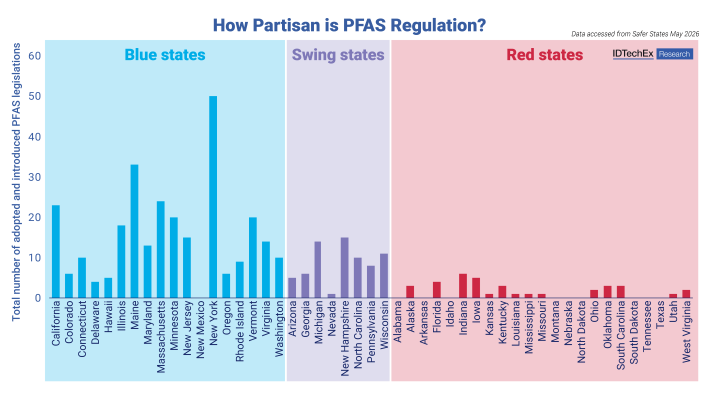
The divide is particularly visible at the state level. “Blue” states average more than 15 introduced or adopted PFAS laws, while “red” states average fewer than two.
Maine and Vermont have introduced some of the more extensive state-level restrictions, covering areas including food packaging, cleaning products, textiles and cosmetics, as well as firefighting foam and pesticides.
Minnesota has taken another broad approach, banning “intentionally added PFAS” in products unless an exception is made by the commissioner. That framework most closely resembles the EU’s proposed restrictions.
The contrasting approaches in Europe and the US mean that companies using PFAS face very different regulatory pressures depending on where they operate.