German engineering giant Dürr is betting big on the future of flexible manufacturing.
The company has unveiled a new oven technology designed to help automakers break free from volatile energy markets and future-proof production lines against supply shocks and rising CO₂ pressures.
The company’s new Qflex technology completely decouples automotive drying ovens from a fixed heat source, allowing manufacturers to switch between natural gas, electricity, and potentially hydrogen without making structural changes to the oven itself.
For decades, automotive drying ovens were built around a single energy source — a limitation now under growing scrutiny as energy prices fluctuate, supply security weakens, and governments tighten emissions targets. Dürr says its latest approach changes that equation entirely.
The company will now roll out centralized heating technology across its oven portfolio, focusing on two energy-flexible systems: the EcoInCure and the EcoSmartCure with Qflex technology.
The systems use a variable heating circuit capable of operating with multiple energy inputs, giving manufacturers far greater control over operating costs and energy resilience.
“It is impossible for anyone to predict today what source of energy will be available in plentiful supply and at a reasonable cost tomorrow,” says Heiko Dieter, product manager at Dürr, in explaining the benefits of the new concept.
“If, for example, the gas supply is interrupted at short notice, there is a risk of costs increasing and even production being interrupted. Energy-flexible ovens guarantee an alternative supply in this case. If a source of energy is no longer economical, operators can switch to another source with minimal effort – without having to interfere with the oven’s structural fabric.
"Choosing a hybrid system also makes it possible to automatically switch to the cheapest energy source depending on the time of day.”
At the core of the system is a standalone central heating module that generates and distributes heat to individual oven zones as required. Because the oven itself remains unchanged, manufacturers can later swap the energy source — such as integrating solar-generated electricity — by modifying only the heating module.
Dürr says the technology is also designed with next-generation energy systems in mind, including electric high-temperature storage units that can capture and store energy for later use.
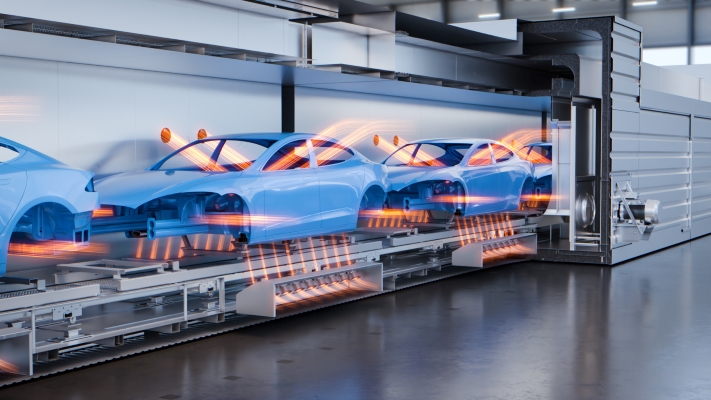
The company’s flagship EcoInCure transverse oven, already deployed in more than 30 paint shops globally, is being paired with the newly developed EcoSmartCure system, which introduces a stop-and-go operating principle aimed at delivering tighter temperature control and improved paint quality.
Unlike conventional ovens that heat large areas continuously, the EcoSmartCure strategically targets heat only where it is needed during stationary phases of the production cycle. Dürr says the approach reduces thermal stress on thicker vehicle components — particularly important for electric vehicles — while improving finish quality.
Both oven systems feature compact, single-level designs that eliminate the need for additional power-unit floors, making them easier to integrate into existing factories and attractive for brownfield modernization projects seeking lower capital and operating costs.
The EcoSmartCure system is currently undergoing industrial testing, but Dürr says customer demand is already strong.
“The strong customer interest and two projects already underway confirm to us that we have hit the mark with this new development,” says Dieter with conviction.
“Energy flexibility is no longer a distant vision. The Qflex technology in our ovens now offers a solution for responding flexibly to volatile energy markets and changing conditions in automotive production.”