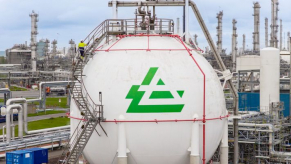
The European Commission has approved €260 million in state aid for a major carbon capture and storage (CCS) project in Belgium, backing an industrial decarbonisation effort led by Air Liquide Large Industry NV and BASF Antwerpen NV.
The funding, cleared under EU State aid rules, will support the Kairos@C project—an ambitious initiative aimed at capturing and storing carbon emissions from heavy industry in Antwerp. Brussels said the measure will help Belgium meet its climate targets by building an integrated cross-border CCS value chain in line with the Clean Industrial Deal.
Belgium notified to the Commission a €260 million measure to support the Kairos@C project, a joint CCS project by the two beneficiaries, Air Liquide and BASF.
The project aims at capturing greenhouse gas ('GHG') emissions from the companies' existing plants, located in Antwerp, that produce hydrogen, ammonia and ethylene oxide. The CO2 captured will be transported to a permanent underground storage site in the North Sea.
The project aims to create an integrated, cross-border CCS value chain at industrial scale, which will result in around 20 million tonnes of net GHG emissions avoided, over 15 years. This innovative project will allow the beneficiaries to produce low-carbon hydrogen and low-carbon ammonia.
Kairos@C has already secured significant EU backing. The project was selected in the first large-scale Innovation Fund call in 2020 and awarded a grant of more than €365 million. But soaring costs—including sharp inflation in recent years—threatened to stall the project.
The Kairos@C project is a laureate of the first large-scale Innovation Fund call of 2020 and was awarded a grant of over €365 million. However, due to, among others, exceptional inflation over the past years, the project costs have significantly increased and as a result it could not start without additional aid.
The new Belgian support will be financed by the Flemish regional government. Under the scheme, both companies will receive an upfront investment grant of €30 million each, followed by annual payments tied to emissions reductions.
The measure will be financed through the budget of the Flemish region. The aid will take the form of a direct investment grant of €30 million per beneficiary, which will be complemented by an additional grant that will be paid out in ten annual instalments of €10 million per beneficiary, provided that minimum GHG emission reductions are achieved.
After assessing the plan under EU competition and climate aid rules, the Commission concluded the subsidies meet the bloc’s criteria for environmental support.
The Commission assessed the Belgian measure under EU State aid rules, in particular Article 107(3)(c) of the Treaty on the Functioning of the EU ('TFEU'), which enables Member States to support the development of certain economic activities under certain conditions, and the 2022 Guidelines on State aid for climate, environmental protection and energy ('CEEAG').
In particular, the Commission found that: The measure facilitates the development of an economic activity. In particular the capture, collection and storage of CO2, as well as the decarbonisation of the production process of ammonia, ethylene oxide and hydrogen;
The aid has an ‘incentive effect', as the beneficiaries would not carry out the relevant investments without the public support;
The aid is necessary and appropriate to promote environmental protection in the targeted economic activities. In addition, it is proportionate, as it is limited to the minimum necessary and does not lead to overcompensation;
The measure has sufficient safeguards to ensure that undue distortions of competition are limited. The aid does not alter the production capacity of the beneficiaries, and if the project generates extra net revenues, the beneficiaries will return to Belgium part of the aid received. The beneficiaries will also disseminate the technical know-how gained through the project.