LANXESS has introduced a highly selective ion exchange resin designed to remove even short- and ultrashort-chain PFAS—pollutants that have long resisted conventional treatment methods.
The challenge is significant. PFAS, widely known as “forever chemicals,” degrade extremely slowly and accumulate in both the environment and living organisms, where they can cause harm.
Short-chain variants, containing just two to seven carbon atoms, are especially difficult to capture. They tend to slip through activated carbon systems and bind weakly in standard ion exchange resins, particularly in the presence of competing anions.
LANXESS says its solution -- Lewatit MDS TP 108 -- changes that equation.
Developed and launched in 2024, Lewatit MDS TP 108 uses smaller, monodisperse resin beads—about one-third the diameter of conventional alternatives—resulting in higher capacity, longer service life, and faster exchange kinetics that maintain performance even under high flow conditions.
A full-scale field trial at fluorochemicals producer Chemours Netherlands B.V. in Dordrecht has now demonstrated its effectiveness in real industrial conditions.
The system achieved removal of more than 99.9 percent of all fluorinated organic compounds from wastewater generated during production.
Chemours operates a three-stage purification system. First, reverse osmosis produces a PFAS-depleted permeate and a concentrated waste stream. Next, activated carbon captures long-chain PFAS to prevent them from saturating the resin stage.
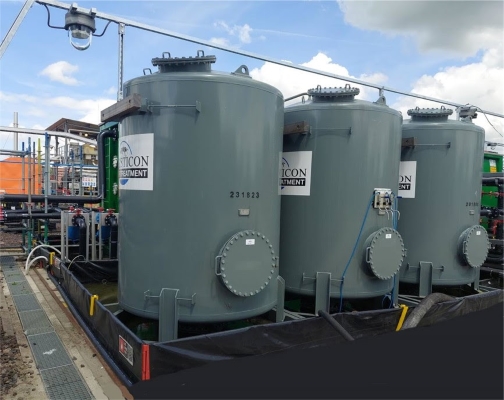
Finally, a cascade of three Lewatit MDS TP 108 vessels—one primary and two polishing filters—targets the most difficult short-chain compounds.
“Our tailored ion exchange resins have bound more than 99.9% of all fluorinated organic compounds from the wastewater. After use, they are incinerated at high temperatures to destroy the PFAS,” explains Björn Dinges, Application Technology Manager at LANXESS.
The treatment plant, designed and delivered by Logisticon Water Treatment B.V., has been in continuous operation at Chemours since mid-2025 following extended trials. It is now playing a key role in reducing site emissions of fluorinated organic compounds.