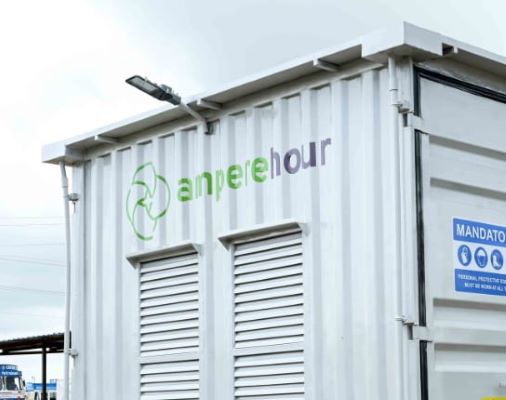
AmpereHour Energy and IndiGrid have commissioned a major 180 MW / 360 MWh Battery Energy Storage System (BESS) at a Gujarat Energy Transmission Corporation substation. This marks one of the largest standalone battery storage deployments in India and among the biggest in Asia.
Backed by Gujarat Urja Vikas Nigam Limited as the off-taker, the project strengthens Gujarat’s rapidly expanding clean-energy backbone and adds significant new flexibility to the state’s grid.
Gujarat has already built momentum with roughly 870 MW of battery storage capacity under development or deployment. Within that surge, this IndiGrid–AmpereHour project stands out as a flagship “lighthouse” installation—demonstrating how large-scale standalone storage can stabilize the grid and enable more reliable renewable integration.
Delivering the project was a major technical leap for AmpereHour Energy, which scaled learnings from its earlier 40 MWh Delhi deployment into a 360 MWh system. To meet GUVNL’s stringent grid requirements, the company’s engineering teams ran advanced simulations across the full electrical architecture—from the 220 kV grid interface down to DC systems—optimizing performance, efficiency, and round-trip energy output.
The build also leaned heavily on AmpereHour’s ELINA EMS platform and its AH Suite software stack to coordinate execution across multiple contractors, manage complex logistics, and maintain quality control through field audits and its “First Time Right” approach.
“This project is a 'lighthouse' moment for the Indian energy sector," said Rahul Shelke, Co-Founder & MD of AmpereHour Energy.
"Our Flexible Integration architecture was the key to this scale; by providing an intelligent, adaptable technology layer, we enabled IndiGrid to deploy a system that is technically superior and commercially optimized. As Gujarat continues to expand its energy storage footprint, we are excited to showcase how our technology serves as the backbone for such critical infrastructure."
For IndiGrid, the commissioning sets a new benchmark in India’s utility-scale storage landscape. The BESS will store surplus renewable energy during low-demand periods and discharge it during peak hours, reducing curtailment and reinforcing grid stability.
"The successful commissioning of this 180 MW / 360 MWh BESS project was a proud moment for IndiGrid and marks an important milestone for India’s evolving energy infrastructure," said Harsh Shah, Managing Director of IndiGrid.
"AmpereHour’s ability to design, integrate and energize a complex Battery Energy Storage System at scale was key to the success of this project. This is a critical asset that underscores our commitment to supporting India's goal of 500 GW of non-fossil fuel capacity by 2030."