Vietnam's success in becoming an additional sourcing point in supply chains stems from a combination of trade policies and infrastructure readiness

India’s chemical industry took root over 125 years ago. Yet its share in the global chemicals market is a mere 4 per cent by value. Contrast that with China, which actualised its modern chemicals industry just ~40 years back. It’s share today is a humongous 43-48 per cent of global chemical sales, and ~16 per cent of all exports by value—the largest by far.
The juggernaut overtook two others—the United States (US) and Germany—not so long back. The flipside to that frenetic growth is a raft of environmental issues and significant overcapacity.
A cautionary tale, but also one that offers hope for India—the sixth-biggest manufacturer in the world by volume and value. The ongoing derisking strategy of global buyers focuses on diversification of supply chains and reducing reliance on China. This approach became popular in 2014-2015 as rising labour costs in China prompted firms around the world to seek manufacturing options elsewhere in Asia.
India can achieve healthy growth in chemicals over the long term by capitalising on export opportunities arising from supply chain diversification. However, higher import dependency for feedstock, pricing disadvantages and limited innovation could constrain the pace and scale of investments in India.
Taking a leaf out of China’s success with industrial clusters and value chains, India should develop capabilities for high-value specialty chemicals by fostering innovation, bringing sustainability initiatives. India should actively pursue cutting import dependence to become a more competitive global chemical hub and reliable partner in the international supply chain.
Global Chemicals Industry and Supply Risk Mitigation
The global chemicals industry is one of the foundations of modern manufacturing. It supports major sectors such as pharmaceuticals, agriculture, automobiles, construction and consumer goods. Hence, any changes in the industry can impact the global economy.
Geopolitical uncertainties, pandemic-related disruptions and rising costs in China have pushed companies to reduce their dependence on a single manufacturing base. This shift underscores the growing importance of supply chain diversification strategies.
China, in value terms, accounted for 43-48 per cent of global chemical sales in 2025. It achieved this scale because of lower costs and by establishing a robust and connected industrial ecosystem over the years.
China invested in feedstock security, large scale infrastructure, integrated chemical clusters and a deep domestic supplier base. It also created end-to-end value chains in which raw materials, intermediate products and downstream industries are located close to each other.
This reduced logistics costs, improved efficiency and helped companies grow faster.
Over time, China also moved into specialty chemicals and advanced materials, which offer better margins and stronger global positioning.
However, many multinational companies are now trying to reduce their dependence on China. Their diversification strategy entails entering countries that can offer scale, cost competitiveness and stability.
For companies, setting up manufacturing units in Southeast Asia and India seems more lucrative than Europe, where plant closures grew sixfold in terms of capacity to 17 million tonne per year from 3 million tonne a year, between 2022 and 2025, according to the European Chemical Industry Council (Cefic).
The lack of energy cost competitiveness is often cited as one of the major reasons for these closures in the region.
Raw Material Imports Offset India’s Competitive Manufacturing Costs, Capabilities
India’s chemicals industry is valued at $210-$230 billion in fiscal 2026 and ranks sixth globally. Yet the country’s share in the global chemicals market is ~4 per cent, which also presents a major growth opportunity.
To make the most of the opportunities arising from supply chain diversification, India must address some major structural weaknesses.
One of the biggest is import dependence. India relies on imported raw materials and petrochemical intermediates such as methanol, acetic acid and phenol. In some cases, such as methanol and ammonia, import dependence is as high as 90 per cent, which could lead to supply risks, increase exposure to global price swings and weaken long-term competitiveness.
India also remains more concentrated in lower-value commodity chemicals, where margins are lower and competition is intense. Higher-value specialty chemicals and derivatives are still often imported or made elsewhere. This limits India’s role in the global value chains.
In addition, infrastructure gaps, uneven cluster development and regulatory delays affect the ease and speed of scaling up production and limits India’s pricing competitiveness.
Building Indian Chemical Ecosystem
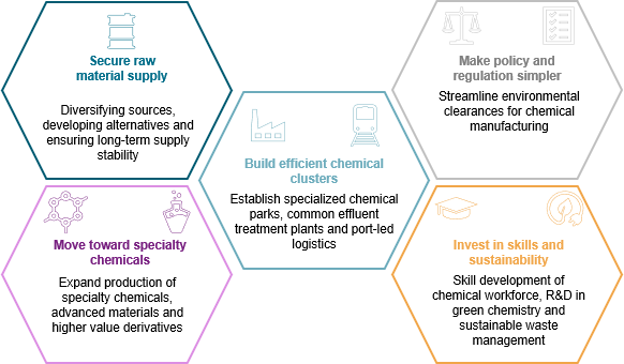
India needs to build a stronger and more integrated chemical ecosystem. This must happen across several connected areas.
Five thrust areas for the industry’s progress
Source: Crisil Intelligence
Secure raw material supply
India's potential to become a major chemical manufacturing hub depends on reducing reliance on imported feedstock by building domestic capacity through backward integration and supporting projects such as coal gasification, green methanol production and crude-to-chemicals processes.
A stronger domestic raw material base will lower import dependence, improve cost competitiveness and ensure supply security for downstream manufacturers.
Build efficient chemical clusters
A competitive chemical industry is underpinned by robust infrastructure, including ports, pipelines, storage, utilities, transport links and industrial services. India has attempted to develop such ecosystems through the Petroleum, Chemicals and Petrochemicals Investment Regions (PCPIRs) initiative, but progress has been slower than expected.
For instance, the Tamil Nadu PCPIR faced significant land acquisition challenges, which led to its cancellation. The process of land acquisition for industrial projects delayed investments, increased costs and heightened local opposition, ultimately leading to the state's decision to cancel the local planning area notification in 2020.
More than a decade after the policy was introduced, only two PCPIRs—one in Dahej, Gujarat and the other in Paradeep, Odisha—are operational. Another one in Visakhapatnam, Andhra Pradesh, is only partially realised, whereas the Tamil Nadu (Cuddalore and Nagapattinam) PCPIR is effectively stalled.
Moving forward, the focus should shift to developing effective chemical clusters built around strong anchor investments such as refineries or crackers, supported by shared infrastructure and efficient logistics.
Move towards specialty chemicals
To improve margins and global competitiveness, India should expand its presence in specialty chemicals used in electronics, renewable energy and advanced manufacturing. Scaling up this segment will require targeted incentives, greater research and development and deeper engagement with global technology providers.
Chlor-alkali products (caustic soda, chlorine and hydrogen) are vital inputs and can support India in achieving chemical self-reliance. The growing demand for downstream chlorine products such as epichlorohydrin and chloromethane can enable chlor-alkali producers to expand, use surplus chlorine, improve profitability and reduce imports.
Strengthening specialty chemicals can help India generate more value, boost exports and cut down dependence on imported high-value products.
Supportive policy and regulation
Policy support is important to attract long-term investment in India’s chemical industry. The industry would benefit from single-window clearances, faster approvals and risk-based compliance. Trade policy should balance global connectivity with protection from unfair competition through measures such as anti-dumping duties, targeted customs policies, export incentives and logistics support.
Domestic feedstock availability is another area where policy has begun to play a direct role. One such initiative that directly supports feedstock security for the chemicals industry is coal gasification. Recently announced, the scheme aims to gasify 75 million tonne of coal with a financial outlay of Rs. 37,500 crore. Through the scheme, India plans to achieve coal gasification of 100 million tonne by 2030.
This is a step in the right direction for gradually reducing import dependence for ammonia, urea and methanol. This will create a diversified feedstock system that is more resilient to global supply disruptions.
Mega coal-to-chemicals complexes are catalysing new downstream clusters in methanol-to-olefins, ammonia derivates and synthetic fuels. Co-location of downstream consumers lowers logistics costs, ensures steady feedstock supply and supports globally competitive manufacturing ecosystems.
Skills and sustainability
A strong chemical industry needs both skilled people and solid infrastructure. India should strengthen chemical engineering and materials science training through education, industry-academia partnerships and specialised programmes, while ensuring compliance with safety standards.
Sustainability is equally important: Investment in water treatment, renewable energy integration and circular economy practices can improve regulatory compliance and acceptance in export markets.
Vietnam, a Major Beneficiary
Vietnam's success in becoming an additional sourcing point in supply chains stems from a combination of trade policies and infrastructure readiness. The country signed free trade agreements (FTAs) with major economies early on, giving manufacturers operating their preferential tariff access to Europe and other major economies, something that directly improves the economics of shifting supply chains away from China.
FTAs have made important contributions toward Vietnam’s export turnover across all traded goods. In 2007, the total import-export turnover was $111 billion (in which export turnover was $48 billion and import turnover was $63 billion). In 2019, the total import-export turnover increased about five times and reached $517 billion. In 2025, the turnover totalled $930 billion, in which, exports accounted for $475 billion, while imports stood at $455 billion.
The Vietnamese government also invested in building industrial parks with ready utilities and logistics connectivity, reducing the time and friction involved in setting up new operations. This helped the country boost exports across various categories of specialty chemicals between 2020 and 2025.
The chemicals sector benefitted as a downstream effect of this broader manufacturing influx. As electronics, textile and consumer goods companies moved production into Vietnam, the demand for industrial chemicals, coatings and solvents grew alongside them.
The chemical industry essentially scaled in response to the manufacturing ecosystem that Vietnam had built around it.
From Opportunity to Strategic Advantage
To sum it up, diversification away from China is seen as an opportunity for India to expand its footprint in the global chemicals industry. Whether this translates into results will depend on how effectively India addresses the required enabling factors.
This would involve strengthening linkages across the value chain, ensuring access to raw materials, improving infrastructure, scaling production of higher-value chemicals, reducing friction in regulations and building capabilities in talent and sustainability.
Subscribe to our newsletter & stay updated.