India’s circular economy is fast shifting from policy concept to economic opportunity, with startups and MSMEs positioned at the centre of a rapidly expanding recycling ecosystem, Union Minister Jitendra Singh has said.
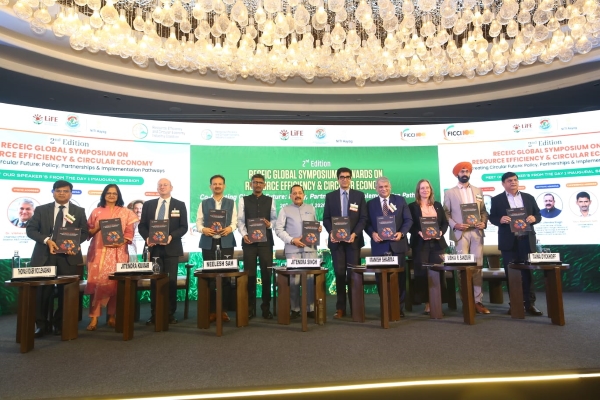
Addressing the RECEIC Global Symposium on “Resource Efficiency and Circular Economy: Co-creating Circular Future – Policy, Partnerships and Implementation Pathways,” Singh said recycling is no longer the exclusive domain of large corporations.
“Recycling is not going to be the prerogative of big business houses alone. It will be a source of economy for all of us and a very strong avenue for startups and MSMEs,” added Singh.
He stressed that circular economy thinking is now transforming the entire value chain—from grassroots innovators to major industries—creating new economic pathways from waste.
Singh also highlighted the government’s push to open up strategic sectors to private participation, including space and nuclear domains, urging industry to respond with innovation and confidence. “Government is a facilitator. The private sector must now step forward with confidence and innovation,” he added.
Underscoring the economic value embedded in waste, the Minister revealed that over ₹4,000 crore has been generated in the last five years through systematic disposal of scrap, including e-waste, under a cleanliness initiative launched in October 2021. “The results demonstrate that there is economic value in every form of waste,” he stated.
He further pointed to practical applications of circularity already taking shape, including the use of plastic and steel slag in road construction and the conversion of used cooking oil into biofuels, illustrating how single waste streams can generate multiple revenue and sustainability outcomes.
At the same event, Neelesh Sah, Joint Secretary, Ministry of Environment, Forest and Climate Change (MoEFCC), highlighted the scale-up of India’s Extended Producer Responsibility (EPR) framework. Introduced in 2016 and digitized in 2022–23, the system now includes nearly 75,000 producers, importers and brand owners, along with around 5,000 registered recyclers.
He also noted that revised Solid Waste Management Rules, notified in January 2026 and effective from April 1, 2026, are strengthening circularity through digital monitoring systems. He emphasized the growing importance of eco-labelling and sustainable lifestyles under the Prime Minister’s LiFE initiative, aimed at reshaping consumption behaviour.
Jitendra Kumar, Managing Director of BIRAC, called for a rethinking of development models through sustainability and circularity. He noted that traditional Indian systems were inherently circular, but industrial growth had drifted away from those practices.
Kumar stressed the importance of the polluter pays principle, stronger regulatory frameworks, and a shift from chemical-intensive processes to biologically driven systems aligned with the BioE3 policy. He also called for a robust carbon credit trading ecosystem to incentivize low-carbon innovation and penalize polluting industries.
Manish Sharma, Chair of the RECEIC Steering Committee, said the 60-member industry coalition is actively working across five key areas—packaging, material transition, used oil circularity, textiles and apparel, and dry cell batteries—with pilot projects already underway.