Experts call for equipping scientists, reforming processes, and building a holistic IPR framework for a stronger agrochemical ecosystem
India stands at a pivotal moment in its journey toward becoming an innovation-driven global leader, especially in the agrochemical sector, where the gap between invention and impact often lies in how effectively ideas are protected, commercialized, and scaled.
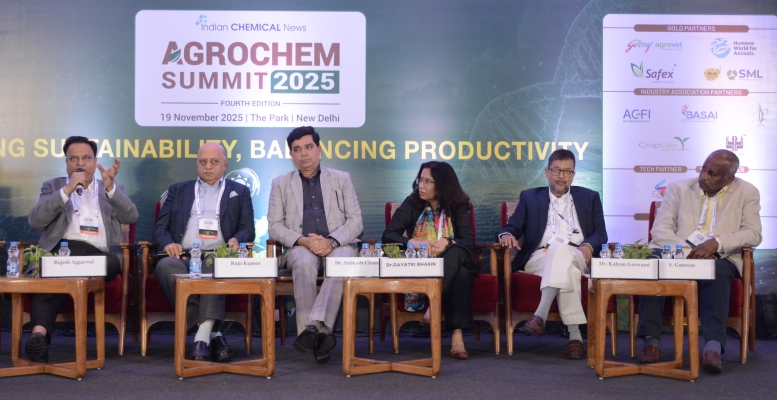
During the recent discussion at the AgroChem Summit 2025 organised by the Indian Chemical News (ICN) on November 19, 2025, in New Delhi, industry leaders underscored one truth: India needs not only an invention strategy but a strong IPR strategy that can sustain innovation, attract investment, and ensure new technologies truly reach the market.
The second session at the event titled “Navigating the Changing Landscape of Patents and IPR’ moderated by Raju Kapoor, Director - Public & Industry Affairs, FMC India, offered a candid and deeply practical look at what it will take for India to move from potential to leadership in the global agrochemical landscape.
Setting the tone of the discussion, Kapoor outlined, “As we all know, our Prime Minister has set an ambitious national goal of positioning India among the world’s top innovation-driven economies. India today stands at a very interesting juncture. First, we have a unique opportunity to position ourselves as a responsible, ethics-driven and compliant partner in global supply chains. Second, the FTAs being signed, and the proposed BTA with the US, all assume that India will continue to strengthen its regulatory alignment, promote innovation, and incentivise global confidence in our systems. This is essential as we evolve into a truly innovation-led economy. Third, the agrochemical sector, in particular, presents a tremendous opportunity. As we heard from many speakers today, several global patents are expiring. This will allow production to return to India, opening large markets for an India-based or more accurately, India-centric but globally integrated supply chain. In a globalised world, nothing is purely local; everything is interconnected. How India positions itself at this moment will be critical.”
Dr. Subhash Chand, Secretary (CIB&RC) & Joint Director (Chem), Ministry of Agriculture & Farmers Welfare, Govt. of India, shared insights on the latest scenario, enormous opportunities and way forward to tap them.
“Within agrochemicals, about 80% of the pesticides used in India are generics. Only 20% are patented molecules. And of the generics, 65–75% are manufactured by Indian companies. That means the opportunity is huge but only if we invest aggressively in R&D. As of today, there are 47 patented molecules whose expiries begin after 2026. These will open massive market opportunities. Consider the example of glyphosate: one patented molecule created an enormous global market. Several such molecules are now approaching patent expiry. When it comes to innovation, the journey of developing a molecule is extremely demanding. The pipeline begins with screening around one lakh molecules. Through multiple levels of filtering lab studies, toxicology, pre-clinical and biosafety analysis, this number narrows down to a few hundred, then to ten, and finally to just one molecule that reaches the market. This process takes around 10 to 12 years and requires an investment of USD 200 to 800 million. This explains why innovation is expensive and why patents play a crucial role in protecting investments,” said Dr Chand.
“Intellectual property rights safeguard the creations of the human mind whether inventions, designs, trademarks or processes. In India, IPR is governed by legislation such as the Patents Act of 1970 and the Protection of Plant Varieties and Farmers’ Rights Act of 2001, among others. Patents encourage innovation by preventing duplication, protecting inventors’ rights and promoting investment in research. They may be granted for utility, design or plant innovations. Developed nations primarily follow a product patent system, while many developing countries adopt a process patent system. Patents, however, have limitations: they are valid for only 15 to 20 years and apply only in the country where they are granted unless filed elsewhere,” Dr Chand added further.
Rajesh Aggarwal, Managing Director, Insecticides (India) Ltd. shared his deep perspective on the innovation landscape within agrochemical industry.
“Over the past two decades, significant advancements have been made in India in manufacturing, and Indian companies have become strong contributors to global supply chains. We have made good technological progress in identifying processes and developing products, and patenting has evolved along the way. Initially, patents were mostly for technical processes, then for product processes, and now, we are seeing patents in formulations where companies can demonstrate a meaningful scientific distinction between two or even three products using new technology. Formulation patents are no longer limited to India; they are becoming a global trend. This shift is also driven by farmers’ needs. In markets like Brazil, farmers prefer single-shot solutions that combine multiple modes of action because they reduce cost, labour and operational complexity. Developing such combination formulations requires technology, data and scientific backing, which is why formulation patents are growing. Many people are not working on completely new inventions, so the innovation is now happening in how we combine, apply and enhance existing technologies,” opined Aggarwal.
“In my own experience, I remember 2013 very well, when I had an opportunity to work with a Japanese company. They were keen to invest in our organisation, but because we were already closely associated with another Japanese partner, we could not proceed. Across several rounds of discussions, one thing became clear: the cost of R&D in Japan was multiple times higher than the cost of carrying out the same R&D in India. With this understanding, we signed an agreement in 2017 to work together on new chemistry. I am glad to say we succeeded in identifying at least three new modes of action, and one of them is already near completion. Innovation is not impossible. R&D is not unreachable. What matters most is clarity of vision. If you decide that R&D investments are not optional but an integral part of your long-term strategy and annual expenditure, innovation becomes a natural outcome,” added Aggarwal.
Dr. Kalyan Goswami, Director General, Agro Chem Federation of India (ACFI), strongly advocates for regulatory data protection (RDP), arguing that India needs new molecules, and that innovators will only invest in introducing them if their data and early investments are protected.
“Around the year 2000, the number of patents was just 200. By 2012, it had jumped to 6,000. And by 2024, it had risen to nearly 14,000. That shows what consistent investment in R&D can do. Over the past six years, I have realised that our R&D efforts have become almost negligible. We are relying heavily on innovations from abroad and on imports from China. On the issue of regulatory data protection (RDP), which my association has been supporting right from the beginning, we need new molecules. But to get them, we need serious investment, something we cannot achieve by simply relaxing norms. There is an opportunity with patent-expired molecules. Companies can bring them to India, but the investment required for field trials, validations, and approvals is significant. The problem is that even if a company invests heavily and gets the first registration, the next year the product gets copied. So why would anyone invest? This is why we argue for data protection to ensure innovators recover their investment and farmers get access to newer, more effective solutions. Old molecules are losing their effectiveness due to resistance; we need fresh chemistry in the system,” said Dr Goswami.
"Even in pharma, the larger companies initially resisted RDP. But today, look at them: they are exporting $36 billion worth of products, six times more than many of our Indian agrochemical manufacturers. And now, ironically, some of those same large companies support RDP because they see the value of protecting innovation. So the debate will continue. We don’t have the time to go deeper right now, but as an association, we remain committed to supporting RDP so that innovation can flourish in India,” added Dr Goswami.
S. Ganesan, Vice President – Policy Affairs, UPL, emphasized that innovation, not just invention, is the true driver of growth and global leadership.
“When we talk about what truly drives growth and leadership today, it is not invention alone but innovation. Of course, invention and innovation coexist, but innovation is what accelerates growth. Even if you look at something like the television, the inventor is not the global leader today; it is companies from Asia that dominate. Innovation wins, and it will continue to win. We recently worked on a paper examining what makes China a global leader. The single most important factor is the strong, consistent support that Chinese industries receive from government-funded research institutions. Nothing else comes close. The data is very clear. For India to stay competitive, we need genuine synergy between private industry and publicly funded research. Government policy has to evolve. China’s policy is very clear, research funded by the government must benefit society and the economy. That connection is missing in India. Too often, research is done for the sake of research. It stays in papers and gathers dust,” said Ganesan.
“In pharma, the global industry is around $1.2 trillion, and almost the entire value comes from the patent-driven segment. It is an industry built on strong IP. Agrochemicals are the opposite. The global agrochemical market is around $78 billion. Out of that, only $5.33 billion worth of products come from patented molecules. When we think of the global market for off-patent pesticides, the first country that comes to mind is China. As an example, there is a compound called Prothioconazole, one of the world’s largest-selling fungicides. The original inventor never registered it in China. But Chinese industry and government did not stay silent. They formed a consortium, registered it themselves, and today China is one of the largest suppliers of Prothioconazole globally. If India wants to catch up with global leaders, significant policy changes are required. We need to examine where our investment is going and whether society is truly benefiting from it. Otherwise, we will continue lagging behind while others move ahead,” added Ganesan.
Dr. Gayatri Bhasin, Principal, Subramaniam & Associates, emphasized that for India to become an innovation-driven economy and a global leader, practical execution is as important as invention.
“Particularly in agrochemicals, innovators face three major hurdles: statutory hurdles under Indian patent law, regulatory hurdles, and procedural hurdles. Companies and scientists in the agrochemical sector face all three, and these hurdles are more complex than those in pharma. That is one reason why agrochemical patents lag far behind pharma patents. Another reason is lack of awareness among agrochemical scientists about patents. I say this as a toxicology scientist. We understand publications and peer-reviewed journals, but we often don’t understand patents. When R&D teams research a topic, they typically review scientific literature; very few look at prior patents. My suggestion to companies is this: regularly train your scientists. Remind them that they are not only researchers but also contributors to business strategy. They must know the difference between what is already known and what can be patented,” said Dr Bhasin.
“Coming to statutory hurdles: for a compound, you must show enhanced efficacy over known compounds. For formulations, you need to demonstrate a synergistic effect. For process patents, you must avoid falling into exclusions like methods of agriculture. So, while companies talk a lot about formulation patents, I would still advise filing a balanced set—a product patent, a formulation patent, and a process patent. Also keep the option of filing divisional applications open, and use it wherever possible. On regulatory hurdles: even if your patent is active, delays in regulatory approvals can reduce your effective protection period. That’s a major challenge. The biggest procedural hurdle is compulsory licensing. Once your patent is granted, if it is not worked in India within three years, a competitor can request a compulsory license on grounds such as inadequate availability or high cost. So costing, market strategy, and timely commercialization all become crucial. Despite these hurdles, the overall picture is positive. With the right strategy, knowing what to file, when to file, and what data to provide, we can strengthen India’s innovation ecosystem,” added Dr Bhasin.
The AgroChem Summit 2025 themed ‘Driving Sustainability, Balancing Productivity’ was supported as Gold Partners by Humane World for Animals, Godrej Agrovet, Safex, and SML.
The industry association partners included BASAI, PMFAI, ACFI, CCFI, and Croplife India.
Subscribe to our newsletter & stay updated.