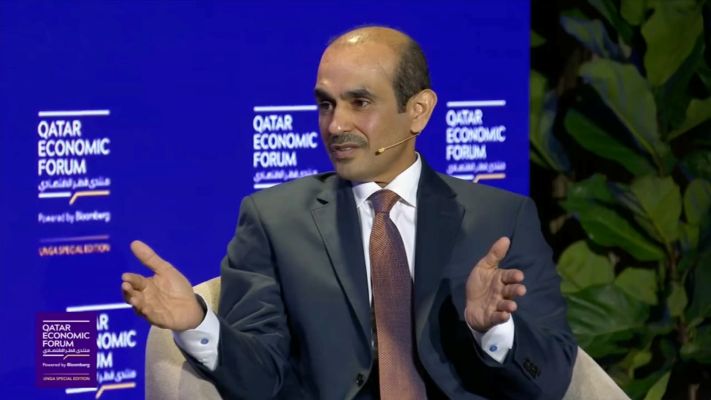
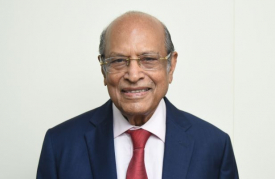
Qatar has ruled out using pipelines as an alternative to the Strait of Hormuz for transporting its LNG exports, with Energy Minister Saad Sherida Al-Kaabi saying the option makes little commercial and economic sense.
Speaking at the Qatar Economic Forum 2026 in New York, Al-Kaabi thanked neighboring countries that have offered the use of their territories for a pipeline route bypassing the strategic waterway, while stressing that pipelines cannot solve the challenge facing Qatar’s main export commodity.
“We are grateful for our neighbors who have welcomed us to use their territories. However, not everything can be transported via pipelines. The problem is that LNG, our main export commodity, cannot be transported by pipelines.
"We will have to transport it by pipelines as gas and then liquify it at receiving terminals wherever that may be. This means we are building redundant facilities to the ones we are already building in Qatar as part of the North Field expansion project. This makes no economic sense.”
“We have decided not to use pipelines as an alternative based on commercial and technical criteria,” Minister Al-Kaabi added.
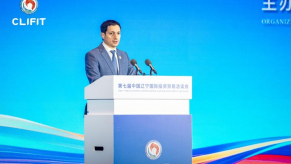
Al-Kaabi, who is also President and CEO of QatarEnergy, was speaking during a session titled “The Global Energy Realignment” at the Qatar Economic Forum, powered by Bloomberg. The 2026 forum was held for the first time in New York to coincide with the 81st United Nations General Assembly high-level meetings.
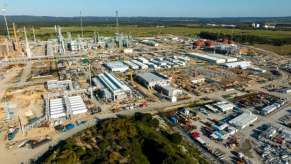
Al-Kaabi said attacks on Qatar’s Ras Laffan gas facilities have damaged two LNG trains and a gas-to-liquids (GTL) plant, with repairs expected to take significantly longer for the LNG facilities.
“Repairs on the GTL train will be concluded in the first quarter of 2027. However, it will take three years for repairs on the two LNG trains.”
Despite the damage, Qatar could resume normal operations relatively quickly once the Strait of Hormuz reopens.
“As for resuming operations,” the Minister added, “Qatar is ready to resume normal operations within a few weeks of the reopening of the Strait of Hormuz.”
Addressing Qatar’s decision to declare force majeure, Al-Kaabi pointed to the country’s record as a reliable LNG supplier.
“Throughout our history, we have been a reliable producer and supplier with zero defaults on any shipment. But this is absolutely beyond our control.”
He also rejected suggestions that the Strait of Hormuz has become obsolete, emphasizing its broader importance to regional trade.
“It is wrong to call the Strait of Hormuz obsolete as this waterway carries trade in all products, not only oil and gas, to and from all its adjacent countries.
Al-Kaabi stressed the need to preserve normal movement through the waterway and maintain relations among Gulf states.
“The countries around the Gulf are neighbors and will remain neighbors for generations to come. Thus, we need to have good relations with our neighbors.”
Al-Kaabi also revealed an ambitious expansion of QatarEnergy’s LNG trading business, saying the company is positioning itself to become the world’s largest LNG trader.
“I have announced in 2024 that we're building one of the largest LNG trading organizations, and I did mention that it is going to be very large. I would like to mention today that, in the very near future, we will be the largest LNG trader in the world by far. And we're building our position to become the largest trader;”
Asked about reports that Qatar was purchasing LNG volumes from the market, Al-Kaabi said the trading expansion is part of a strategy announced in 2024.
Al-Kaabi also highlighted progress on QatarEnergy’s US investments, saying shipments have begun from the first train at Golden Pass LNG.
“We expect next year to have both the second and third trains in full operation. We are also building the largest ethane cracker in the world at the Golden Triangle Polymers project. The project has started its commissioning process as we speak. It should be starting up in the next few weeks.”
The Qatar Economic Forum, powered by Bloomberg, is the Middle East’s leading news-driven event dedicated to global business and investment. The forum brings together global leaders to discuss the economic, energy and geopolitical issues shaping boardroom decisions.