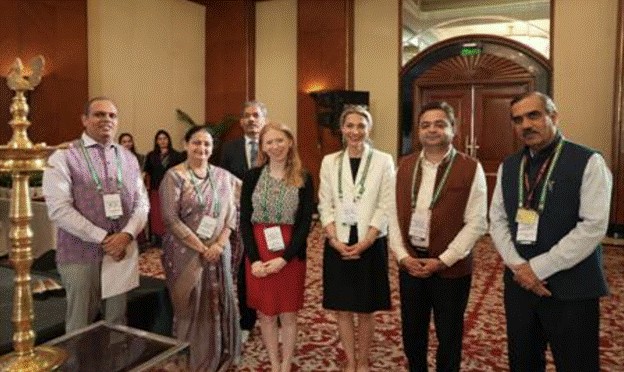
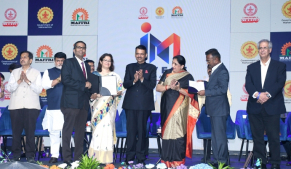
India and the United Kingdom stepped up cooperation on green hydrogen safety and standards at a recent high-level conference in the capital, bringing policymakers, industry leaders and technical experts together to strengthen frameworks for the safe scale-up of the emerging clean fuel sector.
The India–UK Conference on Green Hydrogen Standards and Safety Protocols, held in New Delhi on February 27, convened representatives from government, industry, academia, standards bodies and regulators from both countries. The discussions focused on building stronger regulatory frameworks and safety systems to support India’s rapidly expanding green hydrogen ecosystem under the National Green Hydrogen Mission.
The conference was organised by the National Centre for Hydrogen Safety, established under the Ministry of New and Renewable Energy, in collaboration with the British High Commission in India and WRI India.
Participants examined safety challenges across the entire hydrogen value chain—from production and storage to transportation and end-use—while exploring ways to align India’s emerging standards with global best practices.
The inaugural session opened with remarks by Mohammad Rihan, Director General of the National Institute of Solar Energy. Special addresses followed from Abhay Bakre, Mission Director of the National Green Hydrogen Mission at MNRE; Jinoos Shariati, First Secretary (Trade) at the British High Commission; Anjan Kumar Mishra, Secretary of the Petroleum and Natural Gas Regulatory Board; and Laura Aylett, First Secretary (Climate & Energy) at the British High Commission.
Delivering the keynote address, Parvinder Maini, Scientific Secretary at the Office of the Principal Scientific Adviser to the Government of India, emphasized the importance of strong safety frameworks, standards development, and international collaboration to enable the large-scale deployment of green hydrogen technologies.
A key highlight of the conference was the participation of national regulators responsible for hydrogen safety and standards.
The Petroleum and Explosives Safety Organisation outlined regulatory perspectives on safety compliance, risk assessment and hazard management for hydrogen systems. Meanwhile, the Bureau of Indian Standards shared insights into the evolving hydrogen standards framework and efforts underway to align Indian norms with international benchmarks.
Technical sessions brought together leading voices from industry, academia and research institutions. Experts from the Society of Indian Automobile Manufacturers, NTPC Limited, Automotive Research Association of India, Cochin Shipyard Limited, Arup, CSIR-National Metallurgical Laboratory, Cochin University of Science and Technology, and Indian Institute of Technology Madras shared best practices and emerging innovations.
Discussions ranged from safe hydrogen production, storage and transport systems to risk-assessment methods, incident case studies and emerging technologies such as advanced sensor systems and AI-enabled monitoring for hydrogen safety.
The conference concluded with India and the UK reaffirming their commitment to deepen cooperation on standards development, regulatory capacity building and safety frameworks.
The deliberations are expected to feed into ongoing work under the National Green Hydrogen Mission to build a comprehensive safety ecosystem and accelerate the growth of a reliable and globally competitive green hydrogen sector in India.