Europe’s biggest names in transport, energy and technology are joining forces to push hydrogen-powered trucks from pilot projects into large-scale commercial deployment, with Germany emerging as the blueprint for a continent-wide rollout by 2030.
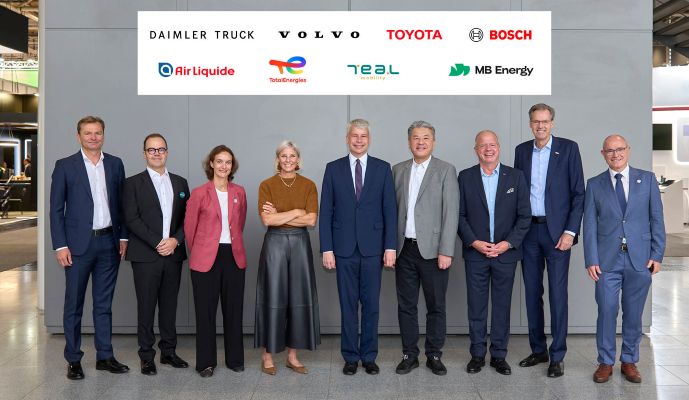
Volvo Group, Daimler Truck, Toyota Motor Corporation, Bosch, Air Liquide, TotalEnergies, TEAL Mobility and MB Energy have unveiled their plans at IAA Transportation, calling for coordinated action from governments and the European Commission to build the infrastructure, supply chains and incentives needed to make hydrogen trucks commercially viable.
For the first time in Europe, the German ecosystem has put in place all the conditions for a scalable deployment of Hydrogen trucks by 2030, driven by the German authorities and European industrial leaders along the value chain.
The industry says Germany’s approach could provide a practical model for other European markets, but warns that continent-wide expansion will require aligned government support, particularly to strengthen energy resilience and industrial competitiveness.
Hydrogen is being positioned as a complement to battery-electric vehicles, particularly for heavy-duty trucking where long range, high payloads, rapid refueling and operational flexibility can make electrification more challenging.
Daimler Truck says customers have already driven almost 600,000 kilometers with fuel-cell trucks. The company plans to put a small series of 100 next-generation fuel-cell trucks into customer operations from the end of 2026, while hydrogen combustion-engine trucks are being prepared for market launch in 2027.
Daimler Truck is investing a mid-three-digit million euro amount in hydrogen trucks by the end of the decade. Volvo Group is also expanding its hydrogen portfolio, investing in both fuel-cell and hydrogen-combustion technologies for commercial rollout toward 2030.
Toyota will support the effort as a technology partner, drawing on more than three decades of fuel-cell development and supply expertise. Bosch is supplying key components for gaseous-hydrogen vehicles, with its fuel-cell system having accumulated more than 30 million kilometers on the road, while also developing refueling technologies for liquid and gaseous hydrogen.
The push extends beyond vehicles. Volvo Group and Daimler Truck are working with energy and hydrogen companies including Air Liquide, TotalEnergies and MB Energy, alongside retail operators such as MB Energy and TEAL Mobility, a 50/50 joint venture between TotalEnergies and Air Liquide operating under the TotalEnergies brand.
The companies aim to expand both liquid and gaseous hydrogen supply chains and develop high-capacity refueling stations capable of serving up to 100 trucks a day.
They also intend to tap into the expanding industrial production of renewable hydrogen as Europe implements the RED III directive.
But the industry faces a critical commercial hurdle: hydrogen must become cost-competitive with diesel if fleet operators are to make the switch.
The companies point to three key levers they say can close that gap: Lower truck costs through incentives and series production. Bring hydrogen pump prices closer to diesel through a more competitive supply chain and greenhouse-gas quota mechanisms. Provide operating incentives, including zero-emission toll exemptions for fleet operators.
Demand is already emerging. Recent applications under Germany’s NOW funding programme were oversubscribed, with industrial companies seeking support for more than 70 high-capacity hydrogen stations and 800 heavy-duty trucks.
The response, the companies say, demonstrates strong commercial interest from the logistics industry.
Germany may be the launchpad, but the industry wants the model replicated across Europe.
The companies are calling for synchronized funding programmes for hydrogen refueling stations and vehicles to help meet Alternative Fuels Infrastructure Regulation targets. They also want harmonized renewable-fuel credit mechanisms, toll incentives and measures to reduce investment risks across the entire hydrogen value chain.
The goal is to coordinate everything from hydrogen production and liquefaction to distribution, refueling and vehicle operation.
Industry leaders argue that combining large-scale industrial investment with targeted public policy could give Europe the foundation to scale zero-emission freight while strengthening its industrial base, energy resilience and employment.
The message from the sector is clear: hydrogen trucking is moving beyond experimentation, but achieving mass adoption will depend on whether industry and policymakers can build the entire ecosystem at the same time.