Moeve has begun construction of the first phase of what the company describes as Europe’s largest renewable hydrogen project, launching a more than €1 billion industrial development in southern Spain that is expected to create 8,000 jobs across the value chain.
The Onuba project, located at Moeve’s Energy Park in Palos de la Frontera, Huelva, will initially have 300 MW of electrolysis capacity, with the option to add another 105 MW. Once operational, it is expected to produce around 45,000 tonnes of renewable hydrogen a year and avoid approximately 250,000 tonnes of CO2 emissions annually.
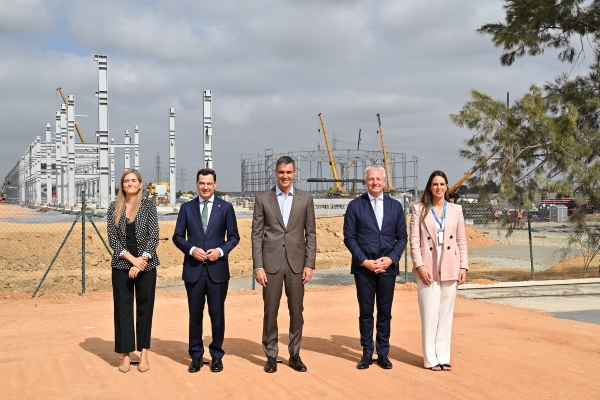
The project has drawn high-level political and business backing, with Spanish Prime Minister Pedro Sánchez, European Commission Executive Vice-President Teresa Ribera and Andalusian President Juanma Moreno Bonilla attending the launch event.
“The Government of Spain is supporting this transformation. But we are doing more than that: we have made renewable hydrogen a true national priority. At a time when very few believed in it, we believed in it, mobilizing the expertise of the Spanish public administration and the resources of the Next Generation EU funds," the Spanish PM said.
"We have done so, on the one hand, through measures aimed at creating a market and stimulating demand, introducing mandatory minimum targets for emissions reductions and the uptake of renewable fuels across all modes of transportation.
"Our goal is to provide investment certainty, expand supply, and facilitate the development of industrial projects across the country. On the other hand, we have already allocated more than €3 billion to more than 120 renewable hydrogen projects. Moeve’s project has received more than €300 million in public funding."
Moreno said the project represented a major statement of intent for the region.
“The construction of the most powerful symbol of all begins here, one that sends a clear message to the world: Andalusia and Spain are ready and fully equipped to play a leading role in the ‘revolution’ toward the clean energy the planet needs".
He added: “We have both an enormous opportunity and a great responsibility in our hands to turn Andalusia into Europe’s leading hub for the production and export of renewable hydrogen.”
Ribera highlighted the project’s European significance.
“The recognition of this plant as a Project of Common Interest by the EU reflects its strategic importance and contribution to the transformation of our energy system. The energy transition should not be viewed as a cost to industry, but as an opportunity to make it stronger, more innovative and more autonomous. For this reason, the start of construction of the Onuba project is very good news for Andalusia, Spain and Europe as a whole.”
For Moeve CEO Maarten Wetselaar, the start of construction marks a shift from demonstration projects to industrial-scale deployment.
“Once again, we are turning ambition into tangible reality. Today, we are turning the page on green hydrogen pilot projects towards the chapter of large-scale construction. The Onuba project reinforces Spain’s position at the forefront of Europe’s sustainable energy production and represents a decisive step towards a more competitive and energy-independent Europe.”
Moeve holds a 51% stake in Onuba. Hy24 and COFIDES hold a combined 29%, while Enagás Renovable and Alter Enersun jointly own the remaining 20%.
The project represents more than €1 billion in investment, including associated infrastructure and a dedicated photovoltaic plant for self-consumption. Moeve expects development, construction and commissioning to generate more than 8,000 direct, indirect and induced jobs and support economic activity among more than 400 local SMEs and self-employed businesses.
The facility will supply renewable hydrogen for more sustainable fuels for road, aviation and maritime transport, while also supporting the decarbonisation of other industrial sectors.
Onuba will also incorporate digital technologies from the outset, including a digital twin and a unified data and IoT platform designed to enable more predictive, efficient and safer operations.
The European Union has designated the project a Project of Common Interest. It has also secured €304 million in Spanish government funding through the Recovery, Transformation and Resilience Plan, financed by the EU’s NextGenerationEU programme. The funding supports the development of 405 MW within the wider Andalusian Green Hydrogen Valley.
Onuba is a central part of Moeve’s broader €2.4 billion investment in energy-transition projects in Andalusia.
The investment also includes a second-generation biofuels facility that is expected to begin producing sustainable aviation fuel and renewable HVO diesel next year. Moeve says the two projects will establish Palos de la Frontera as the site of Europe’s largest green-molecules energy hub.
The wider Andalusian Green Hydrogen Valley is designed to reach 2 GW of electrolysis capacity across Moeve’s Energy Parks in Huelva and San Roque, Cádiz.
Moeve is betting on Andalusia’s land availability, port infrastructure and renewable-energy potential to support large-scale production of green molecules and position the region as a hub for hydrogen technology and industrial development.
The company says renewable hydrogen, second-generation biofuels and biomethane could play a major role in cutting Europe’s dependence on imported fossil fuels, particularly in sectors that are difficult to electrify, including heavy industry, chemicals and long-distance transport.
According to a report by Moeve and PwC, green molecules could halve Europe’s external energy dependence by 2040. The report projects that green molecules could replace up to 50% of current fossil-fuel demand by 2050, account for one-third of Europe’s energy mix and reduce CO2 emissions by 22%.
With construction now underway, the Onuba project moves Europe’s green-hydrogen ambitions from planning and pilot projects into large-scale industrial development.