A complex inter-continental logistics operation has been successfully executed.
deugro Belgium, deugro Netherlands and deugro Oman, on behalf of client Worley, in close collaboration with dteq Transport Engineering Solutions (dteq), have delivered more than 7,324 cubic meters and 1,441 metric tons of critical equipment from Oman to Belgium for INEOS Terminal Expansion Project.
The shipment involved a series of oversized and ultra-heavy modules, some weighing over 200 metric tons. These included three ethylene vessel skids measuring up to 13.05 x 6.08 x 10.83 meters, three refrigerant chiller skids up to 13.50 x 6.00 x 9.90 meters, and three refrigerant compressor skids reaching up to 14.35 x 7.00 x 7.45 meters.
The operation began at the Sohar Industrial Estate in Oman, where the units were picked up using SPMTs and hydraulic trailers. Early inspections revealed a major challenge: several cargo units had been positioned too close to obstacles, preventing direct self-loading. This required a complex double-handling process involving temporary transport solutions before final repositioning for road movement.
Once secured on transport equipment in line with dteq’s load-securing plans and under deugro supervision, the cargo was moved over 18.5 kilometers to Sohar Port. Due to extreme dimensions and strict local regulations, the transport moved at walking speed during night hours, escorted throughout by deugro teams and the Royal Oman Police on public roads, following a detailed route survey conducted by dteq.
Different transport configurations were used depending on cargo type, including four-file 15-axle trailers, four-file 12-axle SPMTs, and two-file 15-axle trailer combinations, all engineered to comply with a strict 14-metric-ton axle load limit.
After 15 days, all units were safely stored at the port—except the refrigerant chiller skids, which remained on trailers for direct loading once vessel operations began.
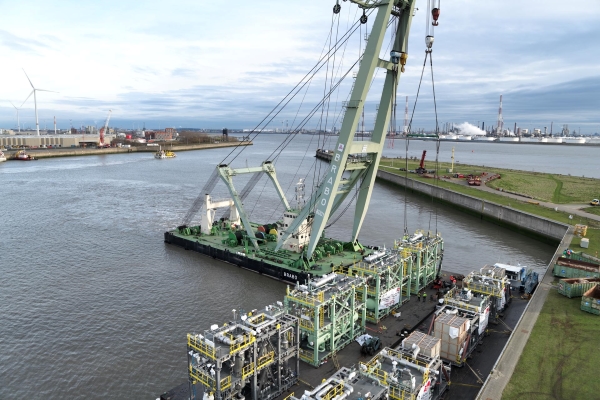
At the quayside, the cargo was moved at controlled speed and loaded onto the vessel using ship cranes, following precise lifting plans. The vessel was positioned strategically to allow safe and direct lifting without interference from previously stowed cargo, minimizing rigging changes and operational risk.
However, a key engineering challenge emerged during lifting preparation. The skids had been designed with lifting lugs for 300-metric-ton shackles, but six of the nine units had top-mounted lifting points that posed significant safety concerns.
As the team explained: “Working at a height of 12 meters with a shackle and pin weighing over 100 kilograms becomes challenging and dangerous. Therefore, we requested approval to use lower and lighter shackles to ensure easier and safer lifting operations.
"Because the lifting lugs could no longer be modified, and because the lifting operation had to comply with the DNV standard as required by the MWS, we immediately arranged for the design, manufacture, and procurement of a set of tailored spacer rings and sleeves for each cargo unit.
"These were pre-installed on the existing lifting lugs to compensate for the significant difference of over six millimeters between the lug and the designated rigging shackle pin diameters, thereby enabling the safe use of 120-metric-ton shackles. This equipment was installed on all cargo lugs as well as on the lifting beam lugs, and it remained on board to be”